


Trump's Democratic SEC pick suggests tokenization policy deserves full rule process
Kristin Johnson, who is expected to join the Securities and Exchange Commission soon as its lone Democrat, argued for revisiting the agency's tokenization "innovation exemption" as a full-fledged rule rather than exemption, she said in a Thursday Senate hearing to evaluate President Donald Trump's nominees for the commission.
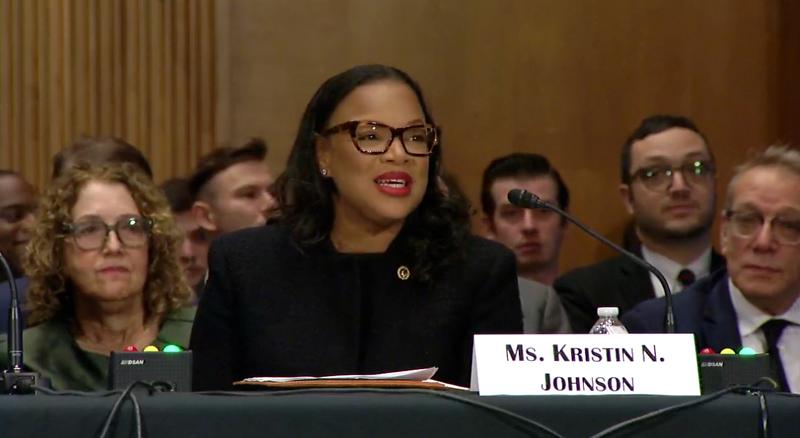
When asked about dozens of companies objecting to having their stock offered through the SEC's new approach to tokenization, which was granted as an exemptionto standing securities regulations, she said she'd "welcome the opportunity" to get the topic into a formal rulemaking that carries a public comment period, "especially when the stakeholders we see raising concerns are in fact market participants, registrants themselves."
"I feel strongly that regulation is made better through the notice-and-comment period, and in fact, it is a requirement by this body that that is how independent federal market regulators approach their responsibility to develop regulation," said Johnson, who had previously served on the Commodity Futures Trading Commission until last year and was — with Republican pick Steven Levine — nominated to join the SEC last week.
On the same topic, which was one of the SEC's most consequential policy decisions so far for the crypto industry, Levine said that the exemption was time-limited and narrow and that "many innovations, such as the exchange traded fund, began as a series of exemptive orders that ultimately resulted in agency rulemaking."
Steven Levine, Republican SEC nominee (screen capture, Senate Banking Committee)
That's what SEC Chairman Paul Atkins said the agency has in mind, doing a formal rule after testing the waters with the exemption.
At the confirmation hearing for Johnson and Levine before the U.S. Senate Banking Committee, the two were among five nominees, including for roles at the Treasury Department and Department of Transportation. The SEC is meant to be a five-member commission, and the two nominees would double its current number to four — three Republicans and one Democrat.
"Artificial intelligence, tokenization, stablecoins, and decentralized platforms promise lower costs
and wider access, and they also raise real questions about conflicts of interest, data governance, and accountability," said Johnson, who has been a professor at George Washington University Law School after leaving the CFTC last year, in her prepared remarks. "In digital asset markets, I have focused on strong governance, conflicts of interest rules, and segregation of customer assets."
She and Levine also fielded questions about prediction markets firms, which Senator Catherine Cortez Masto, a Nevada Democrat, accused of illegally trading "security-based swaps as equity-based perpetuals" in relation to the CFTC's recent allowance for single-stock perpetual futures. Levine didn't commit to a position, and Johnson said there are "very critical and important questions here regarding the jurisdiction and authority of the commission."
The banking panel was instrumental in this year's failed negotiations over the Digital Asset Market Clarity Act — a process Democratic Senator Mark Warner called "a year in crypto hell" — but it's unlikely that the incoming Democrat majority will be as immediately keen on picking up the industry's top priority. Senator Elizabeth Warren, the committee's ranking Democrat who is expected to take over the chairmanship once her party takes the majority in January, has been among the Senate's loudest crypto skeptics.
Warren greeted Levine with skepticism in her opening remarks, asking, "How can we possibly believe that if you are confirmed as an SEC commissioner, that you won't be just another pawn who will put Wall Street profits over protecting American investors?"
The committee will now have to weigh the nominees' suitability and vote on whether to advance them to a confirmation vote of the overall Senate — an outcome expected to happen soon.
Earlier this week, senators on a different panel, the Senate Agriculture Committee, conducted a similar hearing for the president's nominees to rebuild the CFTC: Democratic pick Matthew Rowland and Republican choice Nathan Anonick. In that hearing, senators kept the tone civil, though they asked many questions about the CFTC's role with prediction markets — a particularly controversial policy fight raging between the agency and authorities in many states who oppose the regulator's position that it should have the sole jurisdiction over that sector. That fight has been the subject of dozens of lawsuits and appeals, and may be taken up by the U.S. Supreme Court.
Both the CFTC and SEC confirmation hearings were relatively brief, and there were scant rhetorical fireworks on display at either, suggesting no obvious new reasons that the lawmakers would object to the nominees for each agency. If all are confirmed, it still leaves a Democrat seat vacant at both agencies, and one Republican opening still at the CFTC.
More News

 BTC



 ETH