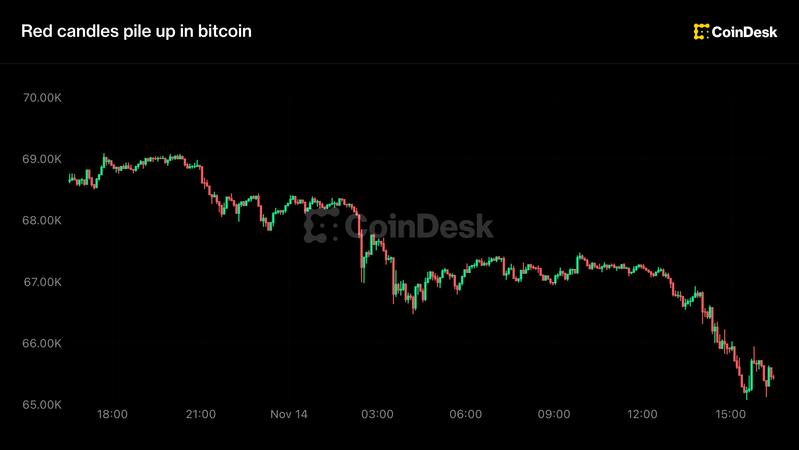
A behind the scenes force may amplify bitcoin and ether price volatility
 BTC
 ETH
That force is market makers, the firms that take the other side when traders place bets on where bitcoin and ether are headed. Their routine hedging is now set to make price swings bigger.
Here’s the idea. Options are contracts that let traders bet on a coin’s price rising or falling. When a trader buys or sells an option, a market maker usually takes the other side of the trade. That way there is nearly always someone to trade with, which keeps the market running smoothly.
Market makers, also called dealers, are not in it to predict prices. They make money from the small gap between the prices at which they buy and sell, and they stay out of the bet on direction. Price moves leave them exposed to direction anyway, so they buy or sell coins, or futures tied to those coins, to cancel it out. That brings them back to market-neutral, meaning they have no bet on direction. This is called hedging.
That hedging can either calm the market or make its swings bigger, and right now it is doing the latter. The reason is how market makers are positioned, which is measured by gamma exposure, or GEX. According to Greeks.Live, GEX is negative, or short, across the price range where bitcoin is currently trading.
So they are likely to sell coins or futures as prices fall, to get their books back to neutral. As prices rise, they are likely to buy coins or futures for the same reason. Either way, their trading could exaggerate the move.
“Both Bitcoin and Ether have slipped into deep negative gamma territory,” Adam, a macro researcher at options platform Greeks.Live, told CoinDesk. “Deep negative GEX means dealers are net short options—largely driven by traders bidding up downside puts or chasing breakout calls. To stay hedged in a short-gamma regime, dealers must trade with the prevailing momentum, not against it.”
Puts are bets on a fall. Calls are bets on a rise.
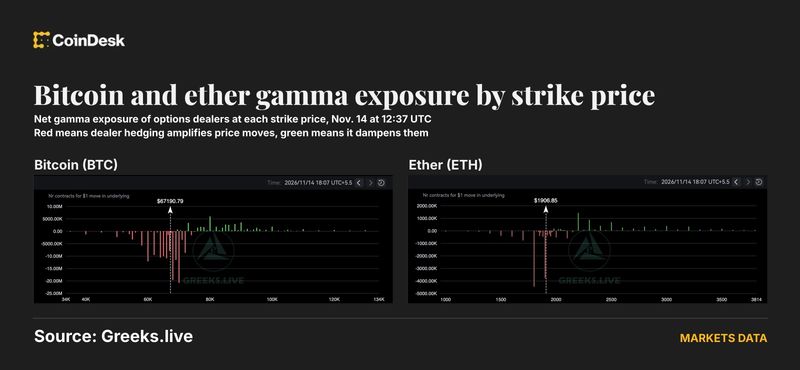
Greeks.Live’s GEX chart for bitcoin shows what that looks like. Each bar shows market makers’ GEX at a price level. At 12:37 UTC on Saturday, with bitcoin near $67,191, the bars are red from about $58,000 to $72,000. The biggest ones sit near $68,000 and $70,000. There is no green below the current price, so nothing softens a drop until the area around the June low of $57,700.
The ether chart shows the same, with price hovering in the red, or negative gamma, zone.
Volatility from market maker hedging could also set off a chain reaction. Adam said even a small dip can snowball into a wave of liquidations across perpetual futures, which are futures contracts with no expiry date. Liquidations are forced closures of leveraged bets, meaning bets made with borrowed money, that go the wrong way.
Negative, or short, gamma works both ways. If BTC and ETH prices start rising here, market makers will likely buy into the rising market, accelerating the move higher.
That tendency would reverse if prices move above $73,000, where the chart shows gamma turning positive. In that situation, market makers would hedge against the market, potentially arresting volatility.
“Until BTC and ETH reclaim their respective ‘gamma flip’ levels—the price threshold where dealer positioning turns positive again—expect fragile order books, exaggerated intraday wicks, and momentum-driven price action.”
GEX changes as prices move and contracts expire, so the picture can shift fast.
Only the chart paragraph changed. In the new chart the bar near $67,000 has shrunk, so the biggest bars now sit near $68,000 and $70,000.
More News