


Monero suffers biggest single-day slide in over 5 months. Here’s why
 XMR

Privacy-focused cryptocurrency monero (XMR) fell more than 11% on Thursday, marking its biggest single-day decline since June 4, according to CoinDesk data. Most other privacy coins, including zcash (ZEC), also fell.
The most likely reason – Back-to-back XMR delisting announcements by major exchanges.
On Thursday, cryptocurrency exchange KuCoin, the 12th largest by 24-hour trading volume, said it will delist XMR on Nov. 30. In other words, users will no longer be able to buy or sell XMR on the platform after that date.
“The XMR/USDT, XMR/USDC, XMR/ETH and XMR/BTC trading pairs will be delisted at 8:00 on November 30, 2026 (UTC). Users are strongly advised to update or cancel their spot trading orders prior to the time above to avoid potential losses. All trade orders will be automatically removed after trading ceases in each respective trading pair,” the exchange said.
This has major implications for the token, according to pseudonymous Hyperliquid contributor PerpetualCow.hl.
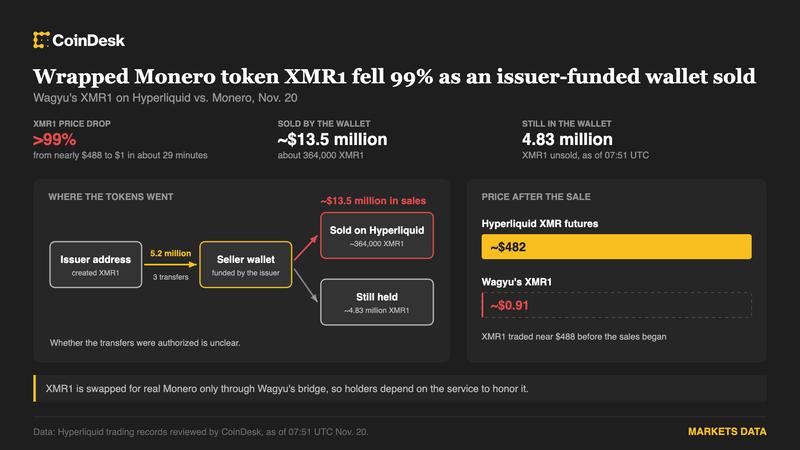
"Over 50% of users sourced their XMR indirectly from Kucoin, it fueled ALL instant swap exchanges. Instant swap exchanges don't have their own liquidity; they simply wrapped around KuCoin and sold/bought into their order books," it said on X. "With KuCoin delisting XMR, Wagyu is actually now the 1 XMR exchange in market dominance; this is crazy."
XMR is trading around $464, having hit a low of $430 on Thursday. The price is down 22% for the month and 14% for the quarter.
This is not the first time a major exchange has delisted the privacy coin, which has long faced criticism over its use in darknet markets and by terror groups.
Earlier this month, MEXC, another top-10 exchange, announced that it would delist XMR spot trading pairs on Nov. 13. Industry leaders including Coinbase International, Binance, OKX and Bitget already do not offer XMR trading.
A total of 73 exchanges delisted the token in 2025 alone, according to TRM Labs.
All this means XMR, despite being a prominent privacy coin, is now available for trading on far fewer exchanges than bitcoin or other major coins. In other words, the market for the token is now increasingly concentrated on a few offshore or unregulated venues.
The Monero community remains unperturbed and has released a new version of Eigenwallet that lets users store both Bitcoin and Monero while keeping full control of their funds.
Its standout feature is a built-in tool called an atomic swap, which lets two people trade BTC directly for XMR. Think of it as a digital vending machine: either both sides receive the coins they agreed to swap, or the deal is canceled, and everyone gets their money back automatically.
Meanwhile, Monero’s upcoming FCMP++ (Full-Chain Membership Proofs) upgrade is advancing through security audits, having debuted on a public beta testnetwork in October 2026.
Once live on the main network, it is expected to boost privacy by hiding each transaction among over 150 million outputs across the entire blockchain, instead of just 16, while adding quantum-safe forward secrecy for transaction history and smoother support for multi-signature and cold wallets.


 USDC