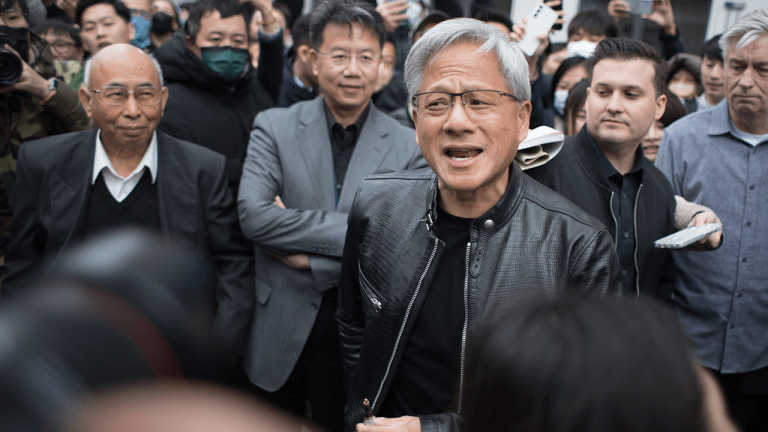
Trump Says He 'Made the Deal' to Reinstate Jensen Huang, Sparking Bipartisan Backlash
 NVDA
Key Takeaways
- President Trump said he "convinced" Nvidia's board to reinstate Jensen Huang, telling CNBC the administration assured directors that Huang posed no national security threat.
- Republicans including Sen. Tom Cotton and Sen. John Cornyn joined Democrats in questioning the decision, and Sen. Elizabeth Warren demanded to know who gave the board "input."
- Trump's own Nvidia stake may have gained up to $15 million on Monday's rally, according to an analysis of his disclosures by the Financial Times.
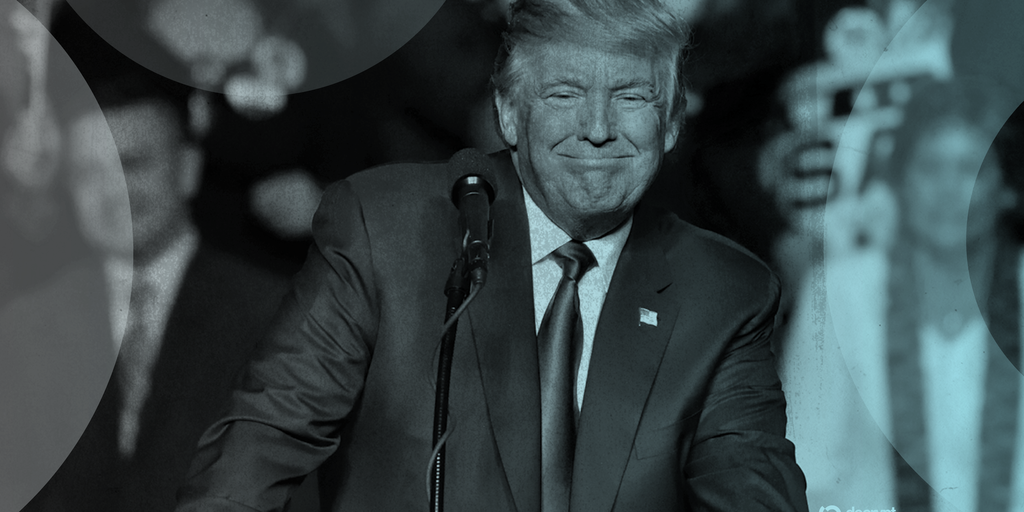
U.S. President Donald Trump has taken credit for Jensen Huang's return to Nvidia, drawing criticism from lawmakers in both parties who say the administration has yet to explain what assurances it gave the company's board.
"I convinced them," Trump told CNBC in a phone interview on Monday, shortly after Nvidia reinstated Huang as president and CEO. "I made the deal."
Did you know?
You can now act on the news you read: Go long or short Nvidia with perpetual futures, all from your Decrypt Money Account.
Trump said the board had asked for assurances that Huang was not a national security threat, and that the administration provided them based on "everything we know." He said a government investigation had found that Huang himself was exonerated. Asked whether last week's stock losses had shaped his view, Trump said "probably so."
The board's decision was sealed by a personal promise from Trump on Sunday, CNBC reported, citing three people familiar with its thinking. Senior administration officials had contacted directors overnight on Friday, and Huang then joined meetings with the board over the weekend, the outlet said. The board's statement cited input from "senior levels of the United States government" without naming anyone.
Attorney General Todd Blanche told Trump and Vice President JD Vance on Saturday that Huang was not the target or subject of any Justice Department investigation, and that there was no evidence he had broken laws, The Wall Street Journal reported, citing U.S. officials.
During a marathon board session on Sunday, Huang disclosed additional affairs beyond the two that had been widely reported, but was contrite, the newspaper said, citing people familiar with the discussion.
Trump told The New York Times that he had consulted Blanche and Director of National Intelligence Jay Clayton before recommending Huang's return. "I had to go to them before I recommended this," he said. A day earlier, Clayton had said that the U.S. investigation into Alice Huang and her former company, Megaspeed, was ongoing.
The reversal came six days after board chair Harvey Jones said directors did not intend to bring Huang back. Trump later posted an AI-generated image on Truth Social showing Huang holding a red bra aloft in his raised fist, in a pose modeled on the photo of Trump after the 2024 assassination attempt on his life.
Backlash from both parties
Huang's reinstatement drew the ire of lawmakers on both sides of the aisle.
"The reckless decision to bring Jensen Huang back as CEO does not change the fact that Mr. Huang, NVIDIA executives, and the company's board still owe Congress answers," Sen. Elizabeth Warren (D-MA), ranking member of the Senate Banking Committee, said in a statement. She called on the administration to explain what input was given, and by which officials.
Republicans also pushed back. Sen. Tom Cotton (R-AR), chair of the Senate Intelligence Committee, tweeted that the controversy over Nvidia and Megaspeed was "not resolved because Jensen Huang has his job back," and pledged to pass chip export-control bills including his Chip Security Act.
I have warned the administration from the start about Communist China obtaining our most advanced chips through both smuggling and remote access. The controversy with Nvidia and Megaspeed is just the tip of the iceberg, and it’s not resolved because Jensen Huang has his job back.…
— Tom Cotton (@SenTomCotton) November 23, 2026
"No national security risk? Based on what?" Sen. John Cornyn (R-TX) tweeted, quoting the board's statement. Sen. John Curtis (R-UT) asked who in government had weighed in and what they told the board, noting that it had ruled out Huang's return only a week earlier. "I'd like to know what changed," he wrote.
Sen. Pete Ricketts (R-NE) tweeted that Huang's behavior "does not support reinstatement," adding that Nvidia still had to answer for national security concerns and "unaccounted-for chips."
Rep. Hakeem Jeffries (D-NY), who is expected to become House Speaker in January, called the board's decision "indefensible, irresponsible and incomprehensible" in a statement. He promised an investigation into Nvidia and into what he called "corrupt abuse of power" by Commerce Secretary Howard Lutnick and his department.
Trump's Nvidia stake
Trump's own Nvidia holdings may have gained as much as $15 million in value on Monday, according to the Financial Times, which calculated that he could have held up to 370,000 shares as of September 30, based on his latest ethics disclosure. At the low end of the disclosure's ranges, he would have held about 32,000 shares and gained $1.3 million. The White House did not respond to the newspaper's request for comment.
Sen. Ruben Gallego (D-AZ) tweeted that the president was "selling out our national security to keep the stock market high," calling for an investigation into stock trades made before the announcement.
Nvidia shares closed up 31.5% at $165.05 on Monday, adding about $950 billion to its market value, before slipping 5% to $156.82 in premarket trading on Tuesday, according to Yahoo! Finance.
Huang is due to sit for a closed-door interview with three House committees on December 1, and to testify before the Senate Banking Committee on December 3. On Monday, the Commerce Department also added Megaspeed to its Entity List trade blacklist.
More News

 BTC

Bitcoin rebound already losing steam as AI trade returns with a bang