Coinbase CEO says AI agents will account for '99.9%' of transactions within a decade
 USDC
 COIN
 Brian Armstrong
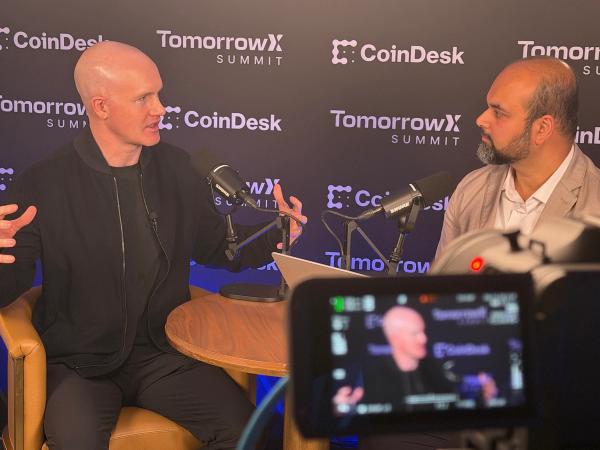
Coinbase CEO Brian Armstrong expects artificial intelligence agents to account for “well over 99.9%” of all transactions within a decade, a shift that could change how money moves across the global economy.
Speaking in an exclusive interview with CoinDesk at the TomorrowX conference in Austin on Tuesday, Armstrong said AI agents will soon outnumber humans and need ways to pay one another for goods and services.
"There's just going to be more agents than humans," Armstrong said. "They might be doing smaller transactions, real-time transactions."
Coinbase is betting that crypto will serve as the payment system for this new economy. The company is building financial accounts, payment tools and marketplaces that allow AI agents to work together and pay for services without human involvement in each transaction.
Armstrong pointed to a business using AI to create an advertisement as an example. Rather than relying on one AI model, an agent could hire separate services for voiceovers, video production and other tasks, paying each provider as work gets done.
Those payments could be too small or frequent for traditional credit card networks. Armstrong said much of the early activity is taking place on Coinbase's Base blockchain using USDC stablecoins.
The push comes as Coinbase seeks new sources of revenue beyond crypto trading, a business that remains sensitive to swings in digital asset prices and investor activity.
The company's earnings have shown how much it still relies on trading fees, though income from stablecoins, staking and custody has helped make up some of the difference when markets slow.
Competition is also heating up. Robinhood HOOD$68.68 has been expanding its crypto business while adding more products for customers who want to trade stocks, options and digital assets in one place.
Prediction markets are another area where the lines are blurring. Polymarket and Kalshi have drawn traders looking to bet on everything from elections to economic data, while Robinhood and Coinbase are pushing into the same market.
Coinbase also faces competition from exchanges such as Kraken and Binance, particularly in derivatives trading.
AI payments could give Coinbase another source of revenue, one that doesn't depend on how many people are buying or selling bitcoin.
Armstrong revealed that he is already using AI agents to trade crypto with his own money — with mixed results.
"I have three or four of them running with different portfolios," Armstrong said. "Some of them are up, some of them are down, to be honest."
Coinbase is developing tools that would allow users to create trading strategies, publish their results and let others copy successful approaches. Armstrong stressed the need for safeguards, including spending limits, account permissions and the ability to test strategies before committing real money.
Armstrong stands by $400,000 forecast for 2030
Armstrong also struck an upbeat tone on bitcoin despite the recent market selloff, which he attributed in part to investors shifting money toward major technology listings.
He compared the decline to an earlier period when investors rotated out of bitcoin ahead of a SpaceX (SPX) IPO, before returning to crypto months later.
Armstrong suggested a potential Anthropic IPO, which plans to close the order books at 4 p.m. ET on Tuesday, finalizing total demand, could be driving a similar shift in investor interest. Still, he believes bitcoin's four-year market cycle remains intact.
"I think we've probably seen the bottom of this cycle," Armstrong said, adding that prices could begin trending higher next year. He also stood by his view that bitcoin could reach $1 million by 2030, calling that target "pretty reasonable."
Beyond bitcoin, Armstrong said Coinbase's business is becoming less dependent on traditional cryptocurrency trading. Prediction markets and derivatives now account for about 25% of the company's trading fee revenue, he said.
The figure underscores how Coinbase is expanding into markets that have become increasingly competitive as crypto trading firms, brokerages and prediction market platforms move into one another's businesses.
He pointed to growth in stablecoins, tokenized stocks and blockchain-based financial services as signs that crypto adoption is expanding even as bitcoin struggles.
More News