Bitget UEX Daily Report | Bitcoin Returns to $80,000; Dow Jones Surges 3%; Crude Oil Plunge Reshapes Inflation Expectations
 BTC
The Bank of England's decision will impact the pound and global interest rate trades; US data will focus on employment resilience and unit labor costs. The sharp drop in oil prices has improved inflation expectations, but firmer evidence of easing inflation will require synchronized movements in wages, productivity, and service-sector prices.
I. Hot News Highlights
US Politics | Democrats Win Control of Both Chambers of Congress, Markets Reassess Policy Pathways
US midterm election results show that Democrats have won control of both the Senate and House of Representatives, meaning the Trump administration will face a divided Congress. US stocks rose broadly across the board that day, while data center, power equipment, and some chip stocks bucked the trend.
Markets are separately pricing in constraints on fiscal expansion, energy policy shifts, and changes in AI regulation. The clear election outcome helps reduce uncertainty, but future policies still need to go through legislative and execution processes. Market expectations should not be taken as enacted measures.
US Economy |ADP Adds 86,000 Jobs, Services Sector Maintains Expansion
The October ADP private sector added 86,000 jobs, with September's figure revised down from 90,000 to 86,000; among these, the services sector added 82,000 jobs and the goods-producing sector added 4,000 jobs. The October ISM Services PMI was 54.5, down from 54.9 in September, but remains in expansion territory.
Employment growth and services sector expansion continue, which does not currently support a call for an economic recession. The next focus will be on initial jobless claims, labor productivity, and Friday's non-farm payrolls, to determine whether cooling demand can coincide with easing inflation.
International Energy |Crude Oil Plunges Sharply, Cost-Sensitive Assets Under Scrutiny
Crude oil fell sharply during trading on November 4. This morning, the WTI December contract was reported at $87.79 per barrel, and the Brent January 2027 contract at $94.56 per barrel. Markets are reassessing US policy shifts and prospects for the Iran conflict, which are key trading drivers at present.
The decline in oil prices is beneficial for easing transportation and production costs, and may alleviate future inflationary pressures; however, profit expectations for energy producers are coming under pressure. Supply and diplomatic developments remain unresolved, so it is still necessary to distinguish between price changes driven by expectations versus actual supply improvements.
II. Market Review
Commodities and FX Performance
Gold and crude oil showed divergent trends. A weaker US dollar and falling US Treasury yields supported precious metals, while crude oil mainly reflected a repricing of supply risk premiums. If oil prices remain low going forward, it will help ease inflationary constraints; however, whether precious metals can sustain their rally depends on real interest rates and capital demand.
Cryptocurrency Performance
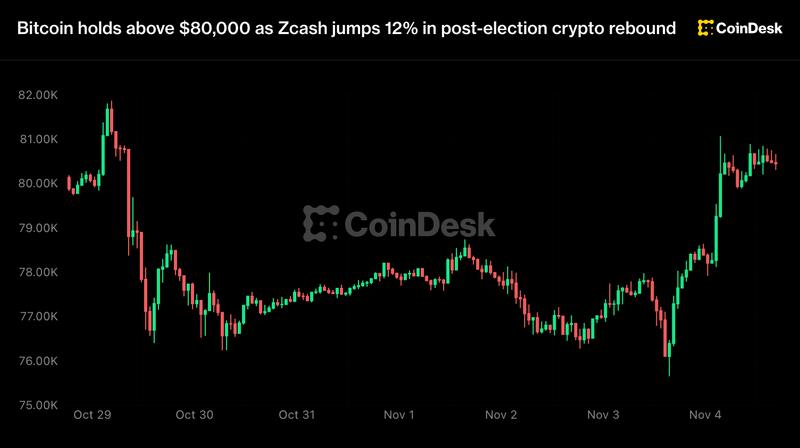
BTC traded at 80,465.19 USDT, up 4.26% over 24 hours; ETH was priced at 2,415.76 USDT, up 6.38% over 24 hours. The total cryptocurrency market cap was approximately $2.71 trillion, up 1.13% over 24 hours. Total market cap independent update time is 09:15 Beijing Time.
BTC/ETH Liquidation Zones: Unverifiable latest data for the main potential liquidation zones above and below the two coins today could not be obtained. Specific ranges, distances, and near-side risk assessments are temporarily unavailable, so old chart conclusions are not carried forward.
Institutional Hold Cost | BTC: The latest disclosure from Strategy on November 2 shows an overall average holding cost of $75,451, with holdings of 849,327 BTC. The current coin price is about 6.58% higher than its cost basis, indicating a reference unrealized gain. Glassnode's estimate of the overall cost basis for US spot BTC ETFs published on October 28 was approximately $81,500. The current price remains about 1.33% lower than this benchmark, indicating a reference unrealized loss; this cost estimate retains its original publication date and is not considered updated for today.
One-Liner Market View: After BTC returned to the $80,000 level, the key focus is whether it can hold this psychological round number and move closer to the $81,500 historical ETF cost benchmark; ETH posted larger gains, reflecting the elasticity of this rebound, but sustainability still requires validation from spot demand and subsequent capital flows.
Major US Stock Index Performance
The Dow led the advance, broadening the market's gains, but index performance masked significant divergence within the AI industry chain. Large platforms and infrastructure suppliers operate on different profit models, so when facing changes in construction pacing, their stock directions may even oppose each other.
Magnificent Seven Performance
Five of the Magnificent Seven rose while two fell. Microsoft and Amazon led the gains, while NVIDIA and Tesla declined. Growing market attention is focused on platform companies' cash flows and capital expenditures. AI demand remains intact, but “selling compute hardware” and “monetizing via compute usage” are no longer priced as a unified narrative.
Notable Sector Movements
AI Infrastructure Under Pressure: Vertiv fell 12.89%, GE Vernova dropped 9.30%, and Micron declined 7.00%. Markets are concerned that future data center construction faces tighter constraints. Going forward, orders, project approvals, and customer capex should be verified; stock price movements alone cannot indicate that orders have been canceled.
Crypto-Related Stocks Rebound: Strategy rose 5.09%, Coinbase gained 4.16%, and Robinhood advanced 2.02%, coinciding with the recovery in crypto spot markets. Equity valuations also factor in operating leverage, multiples, and financing conditions, so they should not be directly equated with BTC directional exposure.
III. In-Depth Analysis of Key US Stocks
Circle CRCL | Revenue Growth Includes Contribution from Token Presales
Event Overview: Circle's total revenue plus reserve income for Q3 was approximately $865 million, up 17% year-over-year; of which, reserve income was about $658 million, down 8% year-over-year, with ARC token presales contributing roughly $182 million in revenue. The stock closed at $76.12, up 1.20%.
Market Interpretation: The simultaneous occurrence of total revenue growth and reserve income decline indicates a shift in growth drivers. Token presale revenue should not be directly viewed as sustainable growth for the stablecoin interest business.
Investment Implications: Future focus should be on the scale of USDC, distribution costs, and whether payment and service revenues outside of token-related income can continue to grow.
Arm ARM | Strong Licensing Revenue, Watch for Delivery Realization
Event Overview: On November 4, Arm reported second-quarter FY2027 revenue of approximately $1.44 billion, up 27% year-over-year; licensing and other revenue reached $773 million, up 50% YoY, while royalty revenue was $670 million. It closed at $191.80 in regular trading, down 5.28%; regular session performance does not reflect after-hours earnings reaction.
Market Interpretation: Growth in licensing revenue provides clues on underlying demand, with data center royalties doubling year-over-year; however, there is a time lag between licensing cycles and future chip shipments or royalty realization.
Investment Implications: Monitor the conversion rate from licensing to royalties, as well as the commercial delivery progress of Arm's proprietary AGI CPUs, to assess whether an expanding revenue structure can yield sustained profits.
Qualcomm QCOM | Mobile Business Under Pressure, Non-Mobile Businesses Enter Realization Phase
Event Overview: Qualcomm reported fourth-quarter FY2026 GAAP revenue of $10.322 billion after market close, down 8% year-over-year; non-GAAP EPS was $2.17, down 28% YoY. The company reaffirmed a data center revenue target of $5 billion for FY2027. It closed at $173.19 in regular trading, up 5.33%, prior to the earnings release.
Market Interpretation: Expansions in automotive and data center sectors offer new growth avenues, but pressures on the core mobile business persist. New business lines must offset changes in existing profit sources.
Investment Implications: Focus closely on volume ramp-up in data center projects, growth rates and margins of non-mobile businesses, and distinguish between guidance targets and realized revenues.
IV. Market and Project Developments
Circle to Acquire Tazapay to Expand Cross-Border Payment Network. The company disclosed that it has signed a definitive agreement to acquire this Singapore-based B2B cross-border payment platform, expected to close in 2027 subject to regulatory approval. The transaction is expected to expand local payment collection and payout coverage, but since closing has not yet occurred, the target's payment volume cannot be directly included in Circle's current business figures.
Glassnode Updates On-Chain Observations, Rebound Still Requires Validation from External Funds. The November 4 weekly report noted that over the past two weeks ending on November 2, US spot BTC ETFs experienced net outflows approaching $1 billion, with spot trading volumes remaining higher than pre-rally levels. This reporting timestamp predates this morning's market action, reflecting funding structure context rather than serving as a single-day ETF result for November 4.
V. Today's Market Calendar
Key Event Outlook: The Bank of England's decision will impact the pound sterling and global rate trades; US data will focus on employment resilience and unit labor costs. The sharp drop in oil prices has improved inflation expectations, but solid evidence of easing inflation only materializes when wages, productivity, and services prices align.
Institutional Views: In its November 4 weekly report, Glassnode suggested that current trading leans more toward internal crypto market capital flowing between assets and platforms, with traditional investors adding limited new funds. This implies that beyond price rebounds, further observation is needed on whether ETF and spot transactions can generate sustained demand.
This article is for market information exchange only and does not constitute investment advice.
Read the original at Techflowpost