
Be Careful With Saylor’s MSTR Pitch as Bitcoin Outperforms Too
 BTC
 MSTR
A closer look at how the digital asset treasury giant Strategy’s stock, MSTR, has performed against bitcoin over the past six years shows that its lead is less consistent than executive chairman Michael Saylor pitches and depends heavily on the dates chosen. It also serves as a reminder of how different the two assets are.
Điểm chính
- MSTR’s outperformance over bitcoin is far less consistent than Saylor’s pitch suggests, with results varying significantly depending on when investors bought.
- Comparing returns across different entry dates shows that MSTR’s amplified exposure does not guarantee better performance, while bitcoin can outperform over the same holding period.
- MSTR and bitcoin serve different investor needs: one offers leveraged exposure to bitcoin with company-specific risks, while the other provides direct ownership of the asset.
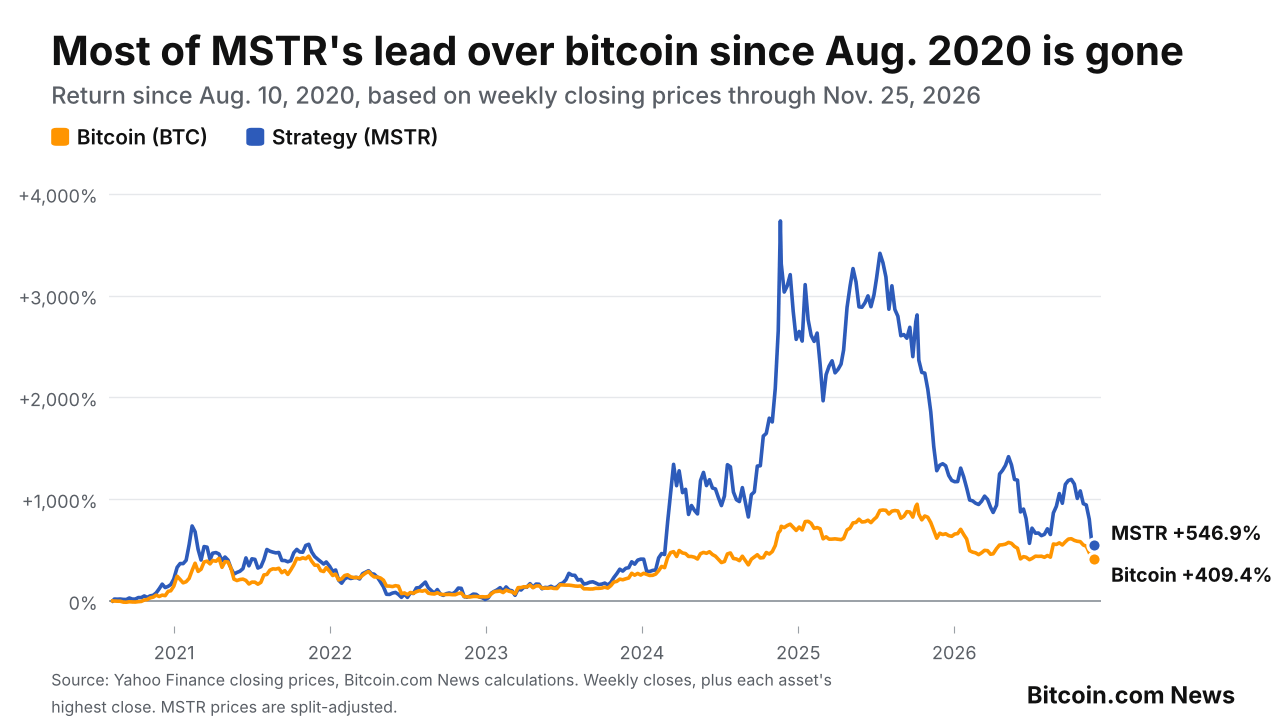
Last week, Saylor posted that MSTR had returned 34% annually (42% in July) since the company adopted bitcoin in August 2020, outperforming bitcoin’s 29% return. Bitcoin.com News also compared MSTR and bitcoin returns from Aug. 10 of each year between 2020 and 2025 through the Nov. 25 market close. Aug. 10 is the date Strategy has used to mark the start of its bitcoin era. For dates that fell on weekends, the previous Friday’s close was used for MSTR. Compared with bitcoin, Saylor’s “amplified exposure” pitch and his reported advice to hold MSTR for at least four years worked out only for some of these start dates.
Different Timeframes, Different Results
Indeed, investors who bought MSTR on Aug. 10, 2020, would be better off than those who bought BTC at the same time. The former is up 547%, compared with 409% for the latter. The next-best entry point for MSTR was Aug. 10, 2023, but the stock has outperformed BTC only narrowly since then. Over the remaining four timeframes, BTC either gained more than MSTR or fell less than the stock.

However, choosing different timeframes can produce different results. On Nov. 16, Caleb Franzen, founder of Cubic Analytics, posted a comparison of BTC and MSTR, claiming that over the past five years, MSTR had returned 33%, while BTC was essentially flat. Over four years, the returns were 524% and 280%, respectively, and over three years, they were 107% and 69%. His four-year window starts in November 2022, just after the FTX collapse and close to bitcoin’s lowest point of that cycle. That timing favors a stock built to amplify bitcoin’s moves. In either case, since Nov. 16, MSTR is down 23%, while BTC dropped around 6%.
Therefore, investors using different timeframes will get different impressions of each asset’s performance.
The Amplified Pitch
Saylor has been pitching MSTR as a way to gain “amplified exposure” to bitcoin, meaning that the stock rises or falls more than BTC’s price. Indeed, the stock has been more volatile. A Strategy chart from early October put MSTR’s 30-day volatility at 94%, compared with 39% for bitcoin. However, as the data above shows, this amplified exposure can also be more evident on the downside.
The same applies to Saylor’s earlier advice. He advised investors to hold MSTR for at least four years, ideally seven to 10 years. Based on Bitcoin.com News’ calculations, this advice worked for those who held the stock for six and three years. However, investors who held it for five, four, two, or one year would have been better off with bitcoin. Other timeframes, such as Franzen’s, could produce different results, highlighting how heavily performance depends on when investors bought these assets.
Different Assets for Different Investors
These comparisons become more meaningful when investors treat MSTR and BTC as different types of assets that serve different investor profiles and needs. This is what Saylor has repeatedly emphasized over the years. However, his claim that MSTR has beaten bitcoin should be taken with a grain of salt, as the data across different timeframes shows.
Also, while bitcoin faces multiple headwinds, MSTR, at the same time, must weather the BTC slump and company-specific challenges. At the Nov. 30 close, MSCI will remove Strategy from its indexes, which could add selling pressure as funds tracking those indexes sell the stock. However, company-specific factors could also help the stock rise faster, for example, if Strategy succeeds in developing its bitcoin-powered financial products.
Saylor has also made clear that Strategy is not chasing the fastest possible growth. During a Nov. 19 investor Q&A, he rejected raising the dividend on STRC, the company’s preferred stock, to 15% or 20% to win back demand, saying a higher rate would add risk for MSTR holders. “We’re playing the long game. We’re not playing the fastest growth game,” he said.
Strategy’s Focus on STRC
In the meantime, the company is focusing more on supporting its preferred stock, STRC, than on buying bitcoin. STRC pays a 12% annual dividend, and Strategy buys it back when it trades below its $100 face value. The company primarily funds these buybacks by selling new MSTR shares, diluting existing shareholders. Last week, $147 million of a $212 million STRC buyback was funded through MSTR sales, while Strategy spent $30 million on bitcoin.
Since launching the buyback program on June 29, Strategy has spent about $2.88 billion buying back preferred stock through Nov. 22. Meanwhile, bitcoin purchases have slowed sharply since late June. Strategy also sold about $432 million worth of bitcoin in the first nine months of the year, although its holdings have since risen above their level before the sales began.
Since early July, Strategy’s bitcoin holdings have grown by only about 7,530 BTC ($458 million), reaching 851,305 BTC ($51.8 billion) as of Nov. 22.
As a result, Strategy’s “BTC yield,” or bitcoin per share, has been declining this year. It stood at +13% for 2026 as of May 25 but had fallen to -4.9% as of Nov. 26.
All that said, investors looking only to maximize returns could analyze these assets more closely and invest in either or both. Meanwhile, for investors who want to actually own BTC, rather than simply gain exposure to it, and benefit from the features of the technology, the choice is more obvious.
Tin tức khác