
Wintermute Weekly Market Report: Bitcoin Breaks Below 200-Week Moving Average, Defensive Strategies Amid Macro Rate Hike Reassessment
 BTC
Bitcoin fell below the 200-week moving average to $65,000, as expectations of Federal Reserve rate hikes and continuous net outflows from ETFs accelerated deleveraging, leaving the market in a defensive posture in the short term.
Author: Jjay_dm (Wintermute OTC Trader)
Compiled by: TechFlow
TechFlow Summary: Bitcoin fell 12.7% this week to $65,400, closing below the critical 200-week moving average. Meanwhile, the US 10-year Treasury yield climbed to 5.15%, and the market's priced-in probability for a December Fed rate hike surged to approximately 92%. Macroeconomic interest rate repricing has become the core driver suppressing valuations for non-yielding assets.
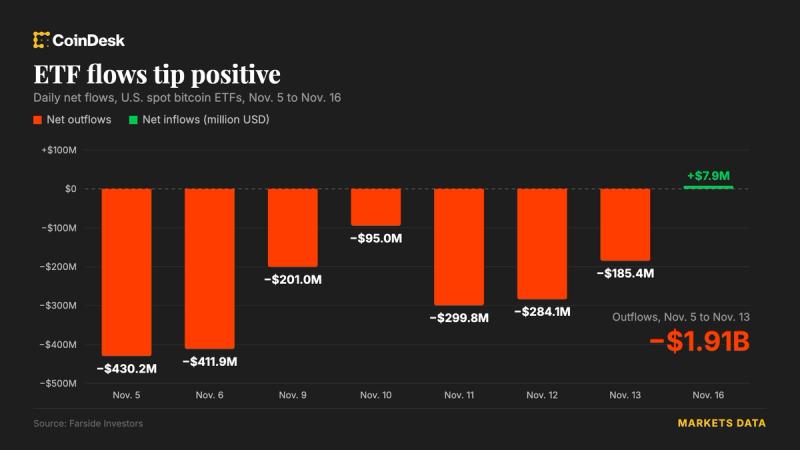
Spot ETFs have seen net outflows of $1.9 billion year-to-date, while the stablecoin market cap shrank by over $1.4 billion within 30 days, causing multiple funding channels to bleed simultaneously. Wintermute argues that July's rebound has been proven to be a bull trap. Before altcoin leverage is thoroughly liquidated and Bitcoin effectively reclaims its 200-week moving average, the path of least resistance remains downward in the short term, requiring a firm defensive stance.
Macro Environment: Rekindled Rate Hike Expectations Put Broad Pressure on Non-Yielding Assets
Following three consecutive months of a 0.3% increase in core CPI, the market's priced-in probability for a December Fed rate hike has surged to approximately 92%. This data point precisely hits the threshold red line previously set by Federal Reserve Governor Waller for "considering a 50 basis point rate hike."
The US 10-year Treasury yield jumped approximately 30 basis points this week, ultimately closing at 5.15%. Among the multiple potential risks we highlighted two weeks ago, interest rate repricing emerged as the most impactful leading factor, while the decline in crude oil prices and the aftershocks of events related to Binance are gradually fading.
In terms of asset performance, Bitcoin plummeted 12.7% this week to close at $65,400, forming a stark contrast with the S&P 500 index's 2.5% gain. Ethereum dropped near $1,800, gold closed at $3,900 after a sharp pullback of about 5%, and Brent crude fell to $96.
The synchronous sell-off across long-duration assets, gold, and cryptocurrencies is fundamentally a classic macro interest rate repricing event. Since Bitcoin inherently generates no cash flow returns, it naturally serves as the funding leg of this deleveraging trade, becoming the asset with the strongest beta attribute and highest vulnerability when trades go wrong.
Chart: Week 46 Cross-Asset Performance Rankings (Source: Wintermute OTC)
This situation has completely shifted the focus of market speculation from "a 25 basis point hike versus holding rates steady" to "a 25 basis point hike versus an immediate 50 basis point hike." The October CPI print will be the final key inflation report the Federal Open Market Committee can review before its December 9 policy meeting.
While a single 50 basis point hike may seem aggressive, bond markets and macroeconomic discourse are reshaping a consensus: the Fed has fallen behind the curve on inflation control and must take more decisive tightening action.
Additionally, US tech giant Nvidia continued its downtrend following Jensen Huang's resignation on Thursday. Given the high correlation between the recent crypto market pullbacks and the Nasdaq index, Nvidia's Q3 earnings report, due Tuesday, will be the largest external risk variable for Bitcoin facing the US equity market this week.
US equities have absorbed interest rate shocks through strong earnings, whereas crypto assets are bearing the brunt via ETF redemptions. This divergence lies at the heart of why the crypto market suffered severe losses this week.
Crypto Assets: Bear Market Has Not Ended, Multiple Funding Channels Continue to Bleed
It is now clear that the crypto market has not truly exited the bear market quagmire, and the rebound since the July low has been confirmed as a bull trap. Bitcoin not only lost the $80,000 level and the 50-week moving average we highlighted on November 2, but also closed on weekly charts below the 200-week moving average near $68,000.
This technical breakdown directly eliminates short-term rebound space, while dropping to $62,000 on Saturday marked the lowest level since July.
Chart: Bitcoin Price vs. 50-Week and 200-Week Moving Average Trends (Source: Wintermute OTC)
From a capital flow perspective, spot Bitcoin ETFs have recorded cumulative net outflows of approximately $1.9 billion year-to-date in 2026, compared to net inflows of $21 billion in 2025 and a staggering $35 billion in 2024. The core buying momentum that supported the bull market over the past two years has completely reversed.
Over the past 30 days, total stablecoin supply evaporated significantly by $14 to $16 billion, with no new offshore dollar inflows entering the market.
On the other hand, MSCI will remove MicroStrategy after the November 30 market close. The current spot Bitcoin price is approximately 14% below its average cost basis of $75,500. Corporate treasury demand from similar entities continues to shrink, and the premium margin that supports their financing faces severe compression.
From ETFs and digital asset treasuries to retail and institutional capital, all liquidity channels are broadly flattening or trending downward. Only if these capital flows see a decisive reversal can a true uptrend potentially re-establish itself.
This is also why we do not view recent liquidation cascades as a market bottom. In the 24 hours leading up to Sunday, global liquidations totaled approximately $170 million, with long positions accounting for roughly 80%, and funding rates across major exchanges turned broadly negative.
The subsequent rebound resembles a liquidity snap-back triggered by short covering rather than fresh external capital entering to buy the dip. At current price levels, we see almost no willingness for incremental funds to step in.
Another core concern lies in market leverage ratios. Currently, the open interest scale for altcoins remains nearly double that of Bitcoin, meaning this retail-dominated high-leverage sector still has substantial unrealized losses awaiting liquidation. We do not believe the altcoin sector can hit a bottom prematurely before thorough deleveraging occurs.
Furthermore, there are no catalysts on the policy calendar capable of restarting capital inflows. The CLARITY Act has not scheduled a Senate vote before its January 3 expiration, making it unlikely to expect clear compliance tailwinds from legislation this year.
Trading Strategy: Firm Defense in the Short Term, Closely Monitor Signals of a 200-Week Moving Average Reclaim
The current market is essentially a landscape entirely dominated by macro interest rates: Bitcoin has degenerated into a discount funding vehicle with no yield, ETF buying momentum is receding, and key technical structures are broken. Therefore, we maintain a comprehensive defensive posture. The path of least resistance remains downward, and the short-term trend is more likely to persist as weak consolidation intended to shake out holders.
A December rate hike being fully priced in, the 10-year Treasury yield climbing to 5.15%, and core CPI touching the red line constitute a macro combination punch identical to the eve of the 2022 market crash. At that time, higher real yields forced capital to simultaneously reduce exposure to long-duration bonds, gold, and crypto assets.
The market has already fully priced in three cumulative rate hikes by March next year, with potential hikes remaining in subsequent months. Accompanied by continued capital outflows and the loss of the 200-week moving average, we anticipate further price deterioration into the $50,000+ range. Saturday's $62,000 low serves as the first test level, while heavy put option open interest at $60,000 on Deribit will be the next major gravitational node.
We are not attempting to blindly guess the absolute market bottom here, as precise bottom-fishing is nearly impossible during intense clearance cycles. For patient, high-conviction multi-quarter cyclical capital, the area below the 200-week moving average is indeed beginning to offer left-side allocation value on a risk-reward basis, but this is entirely separate from short-term trading position management.
We hold strong conviction in this macro assessment while maintaining high flexibility and agility in our positions.
We will lift our short-term comprehensive defensive posture if either of the following two conditions is met: First, Bitcoin strongly reclaims the 200-week moving average near $68,000 at the daily candle close, accompanied by clear net inflows in spot ETFs that day; Second, Wednesday's FOMC minutes or the upcoming October PCE data completely eliminate market expectations for another rate hike in January next year.
With holidays approaching and exchange liquidity thinning, any unexpected news can easily trigger exaggerated one-sided moves. This week, please focus closely on comments from Fed officials, Nvidia's earnings report, and liquidity transmission among macro assets.
Tin tức khác