Bitcoin lags stock rebound in advance of U.S. inflation report
 BTC
 BLK
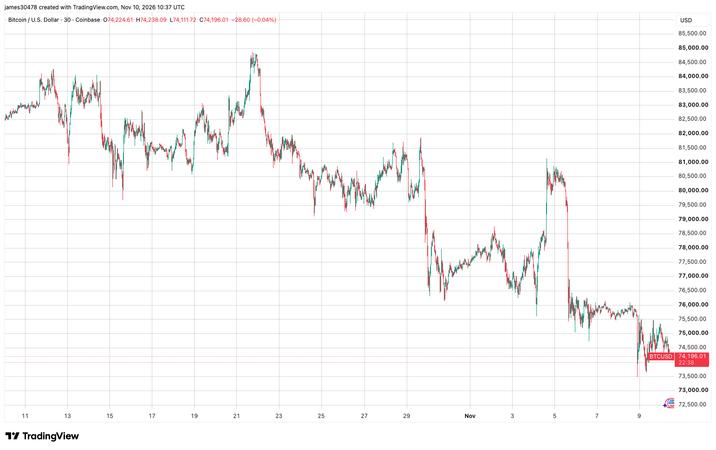
Bitcoin fell to around $74,200 since midnight UTC, with an overnight low of $74,100 ahead of a U.S. inflation report that’s forecast to show consumer price increases slowed in October.
Ether lost 1.4% and the CoinDesk 80 (CD80) slipped 0.2%, while the CoinDesk Memecoin Index (CDMEME) bucked the trend with a 0.4% rise.
The U.S. consumer price index is due at 13:30 UTC. Economists polled by Dow Jones expect headline inflation to have risen 0.3% and core inflation 0.2% last month, slower than September’s 0.6% and 0.3%.
U.S. stocks rebounded on Monday, with the S&P 500 index posting its best day since April 8 and the Nasdaq Composite rising 2.7%, recovering part of last week’s AI-led selloff. Bitcoin, the largest cryptocurrency, is little changed over the past 24 hours.
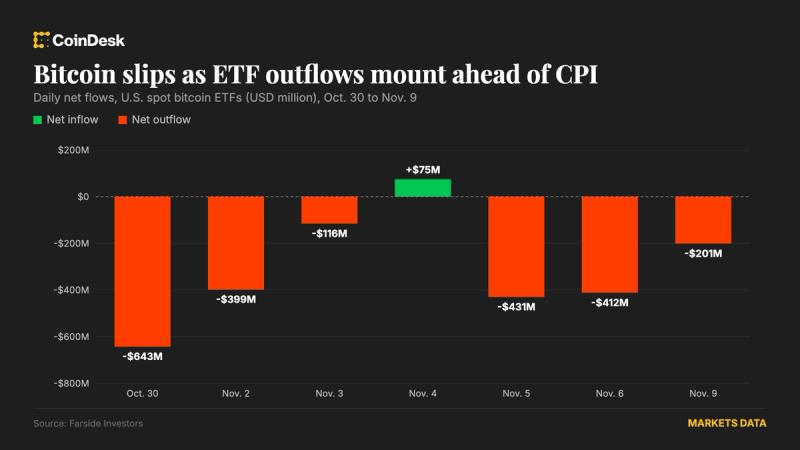
U.S. spot bitcoin ETFs lost $201 million on Monday, according to Farside Investors, led by $213.2 million of outflows from BlackRock’s IBIT, which has now posted seven straight sessions of redemptions.
Derivatives positioning
- Liquidations ease: Crypto futures liquidations fell about 84% to $184 million in 24 hours from more than $1 billion on Monday. Trading volume fell 8.55% to $165.2 billion, while open interest edged up 0.59% to $128.4 billion, so trading cooled and little net money moved in. The taker long/short volume ratio, which tracks market orders, was 49.69% buying to 50.31% selling, an almost even split.
- Funding mostly positive: Annualized funding is moderately positive for most major coins, including bitcoin and ether , meaning longs pay shorts. GRAM, the token formerly known as Toncoin, stands out with funding at about minus 60%, indicating overcrowding in short, or bearish, positions.
- CVD mixed: Cumulative volume delta (CVD) tracks market-order buying against market-order selling, and here it is adjusted for open interest. Over 24 hours it is mixed across multiple coins. GRAM, hedera and tron show the most market-order buying, while zcash (ZEC), uniswap (UNI) and XRP (XRP) show the most selling.
- Majors see little activity: BTC’s notional open interest rose 0.70% against a 0.25% price gain. ETH open interest rose 0.72% while price slipped 0.35%, and in solana (SOL) open interest rose 1.94% while the price fell 1.06%. The moves are small, but in all three money came in even as price held flat or fell.
- HYPE and XRP see money leave: Open interest in HYPE fell 1.14% even as the price rose 1.62%, so money left the market during the rally. In XRP, open interest fell by 3.83% while the price dipped by 0.69%. XRP also shows some of the heaviest market-order selling.
- ZEC OI decline is mostly price effect: ZEC open interest fell 3.31% against a 5.41% price drop. Open interest fell by less than the price, so the decline is mostly the lower price, not a large exit of money. ZEC does show the heaviest market-order selling in the CVD chart.
- AVAX sees capital inflows: Open interest in AVAX, the token of the Avalanche blockchain, rose 13% over 24 hours against a 5% gain in price a sign that money flowed into the futures well beyond what the price move alone would explain. CVD is negative, meaning market orders skewed toward selling even as price rose, and annualized funding is about minus 6%, meaning shorts pay longs. The rally followed Ava Labs' Nov. 9 announcement that Avalanche will be the core ledger for clearing and settlement on an NYSE-affiliated platform for tokenized securities.
- Options skew favors puts in BTC: In bitcoin options, the 25-delta skew is positive across expiries, about 10% at one week, meaning puts carry a premium over calls. One-week at-the-money implied volatility, the price swings options traders expect, is about 38%. Puts dominate the most-traded contracts, led by the 74,000 put expiring Nov. 13.
- ETH options volume leans to calls: In ether options, one-week skew is also positive at about 11%, so puts still carry a premium, but the most-traded contracts are mostly calls, led by the 2,600 call expiring Dec. 25. At-the-money implied volatility is flat across expiries at about 53% to 54%.
Token talk
- Avalanche (AVAX) is up 5% over the past 24 hours after the New York Stock Exchange picked the blockchain for clearing and settlement its planned 24/7 tokenized securities platform. The token slipped 2.6% since midnight UTC. XDC Network , a layer-1 chain focused on tokenizing real-world assets, led the CoinDesk 100 on Tuesday, rising by 7% since midnight UTC.
- Privacy coins gave back last week’s relative strength. Monero (XMR) fell 7.8% over the past 24 hours and zcash (ZEC) 6.3% as traders rotate into real-world asset tokens.
- Hyperliquid (HYPE) was listed on South Korea’s Upbit, the country’s largest exchange, at 06:00 UTC, but is down 0.9% since midnight UTC at around $74.50, roughly 22% below late October’s $96 peak.
- Pieverse (PIEVERSE), a project that lets AI agents transact from messaging apps such as Telegram and WhatsApp, is one of the day’s top performers, rising around 30%. The project teased an AI agent trading desk on X in recent days but has not yet announced the launch.
- CoinMarketCap’s “Altcoin Season” index is 40/100, tumbling significantly from this time last month, when it was at 62/100.
Tin tức khác