Bitget UEX Daily Report | Nasdaq Plunges, Nvidia Investigation Intensifies AI Sell-Off; Bitcoin Reclaims $60,000 Over the Weekend (November 23, 2026)
 BTC
NVIDIA investigation intensifies AI selloff, major U.S. stock indices come under pressure, Bitcoin rebounds over the weekend to reclaim $60,000.
Author: Bitget
Top News Highlights
AI and Regulation: NVIDIA Accounting Probe Adds Uncertainty
On November 20, Reuters cited sources stating that the SEC is investigating NVIDIA's accounting issues, with specific details undisclosed. The probe has yet to reach a conclusion and should not be construed as confirmation of violations.Reuters
U.S. Economy: Consumer Confidence Rises, Inflation Expectations Cool
The final reading for the U.S. University of Michigan Consumer Sentiment Index for November came in at 51.5, up from 48.0 in October; one-year inflation expectations fell from 4.7% to 3.7%, and long-term inflation expectations dropped from 3.5% to 3.3%. The survey shows improved consumer sentiment, though overall conditions remain weak, with inflation remaining a primary concern for households.
For markets, demand remains resilient alongside easing price pressures. The next step is to see if actual consumption and PCE data can confirm this combination; confidence surveys alone are insufficient to conclude that rate pressures have eased.
Weekend Policy: Chinese Exchanges Lower Margin Requirements for Margin Trading
On November 22, the Shanghai, Shenzhen, and Beijing Stock Exchanges announced that the minimum margin requirement for buying on margin will be reduced from 100% to 80% starting November 30; the Shanghai and Shenzhen exchanges also unveiled fee reduction arrangements. These measures help lower trading costs and ease financing constraints; on Monday, we will watch whether trading volume and market absorption improve.
Market Review
Analysis of Market Movements
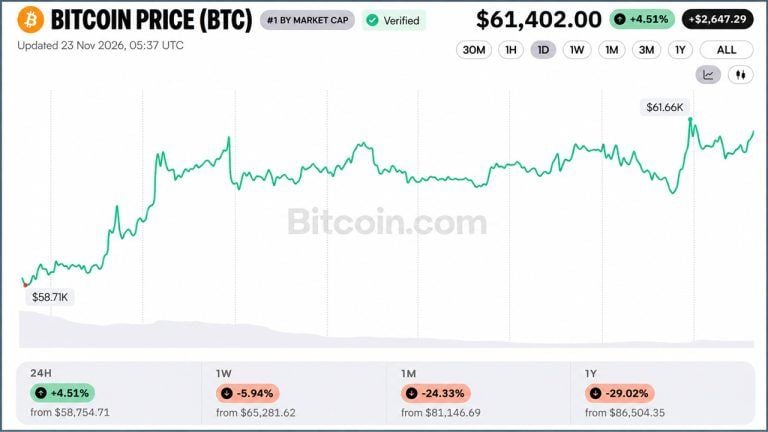
Market Performance: The Nasdaq Composite fell 5.28% on Friday, the S&P 500 declined 3.70%, and the Dow Jones Industrial Average dropped 1.93%, with all seven Mag Stocks closing in the red. NVIDIA fell 14.01%, AMD and Micron both dropped over 13%; CoreWeave and Nebius fell 12.02% and 16.11%, respectively. Bitcoin briefly dipped to around $55,252 over the weekend before recovering above $60,000, showing post-selloff stabilization.
Logic 1: Markets Are Questioning Who Ultimately Bears the Cost of AI Investment. Growth in chip sales only proves that infrastructure spending remains strong; it does not directly confirm that ROI has been realized for cloud providers and model developers. If end-user revenues fail to keep pace with compute, power, and financing expenses, future expansion will rely more heavily on continuous fundraising, making high growth expectations across the industry more vulnerable to downward revisions.
Logic 2: High Rates Simultaneously Suppress Valuations and Raise Expansion Thresholds. For companies whose profitability remains distant and who still require substantial external capital, rising borrowing costs erode returns on new projects and reduce the present value of future cash flows. The sharper declines of newer cloud providers compared to some established tech firms align with the market re-evaluating funding capacity versus cash flow quality.
Logic 3: Key Name Risk Is Spilling Over Into Crowded Positions. NVIDIA's sharp selloff weakened the pricing anchor for the AI sector; chips, cloud compute, and supporting hardware tied to the same theme faced pressure accordingly. The fact that a drop in U.S. Treasury yields on Friday failed to halt tech stocks' decline indicates the day's selloff also involved risk exposure contraction, which cannot be explained solely by interest rate movements.
Commodities & FX Performance
Precious metals softened alongside risk assets, indicating safe-haven demand did not uniformly flow to all assets; Treasuries received some support. Crude oil rebounded on Friday, while a weekend attack on industrial facilities in Bahrain renewed supply risk concerns; energy prices will continue to depend on both demand fundamentals and Middle East geopolitical developments.
Cryptocurrency Performance
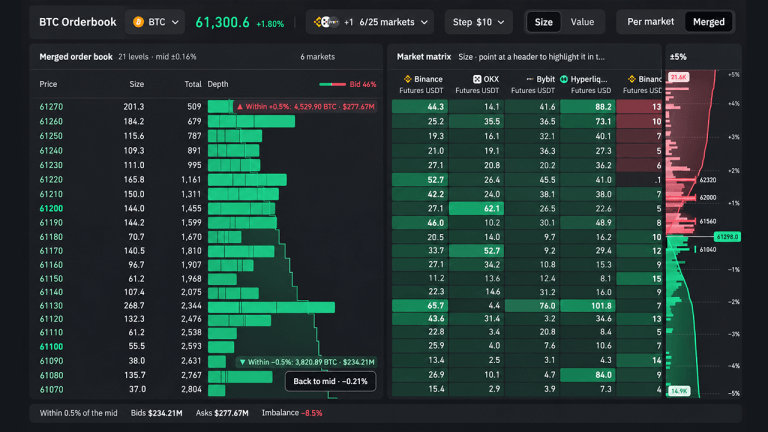
BTC traded at 60,940.92 USDT, up 1.05% in 24 hours; ETH was priced at 1,712.92 USDT, up 1.35% over the same period. The total cryptocurrency market cap stood at approximately $2.11 trillion, down 2.18% in 24 hours, with a 24-hour trading volume of roughly $62.53 billion; aggregate data as of 10:55 PM on November 22.
BTC | Liquidation Level Watch: The most notable potential short liquidation cluster above is approximately $61,400 to $62,300, representing a 0.86% to 2.34% upside move from current levels; the potential long liquidation cluster below sits around $60,000 to $60,600, a 0.45% to 1.43% downside move. Levels below are closer, so pullbacks into this zone warrant monitoring for potential long liquidations amplifying volatility.
ETH | Liquidation Level Watch: The notable potential short liquidation cluster above is roughly $1,720 to $1,740, a 0.52% to 1.69% upside move from current prices; the potential long liquidation cluster below lies around $1,675 to $1,695, a 0.94% to 2.11% downside move. Levels above are closer, so rallies into this range should be monitored for potential short squeeze acceleration.
Institutional Position Cost | BTC: Strategy disclosed on November 16 that as of November 15, it held 850,849 BTC with an average acquisition cost of approximately $75,452 per coin, including fees. The current price is about 19.32% below this average; this gap reflects the difference between market price and acquisition cost and does not represent the company's overall financial return.
Market Snapshot: Focus on BTC support near $60,000–$60,600 and its sustainability above $61,400; watch ETH's bounce performance near $1,720–$1,740. After reclaiming key round numbers over the weekend, further confirmation of recovery strength will require alignment from Monday's U.S. equities and ETF fund flows.
U.S. Equity Major Indices Performance
Both the S&P 500 and Dow Jones have pulled back more than 10% from their historic closing highs, entering what is typically defined as a correction phase. The S&P 500 extended its losing streak to seven consecutive sessions, indicating market stress has broadened beyond a single major stock.
Magnificent Seven Performance
Zero gains and seven losses among the group, with NVIDIA and Tesla leading the declines, while Apple showed relative resilience. Next, monitor whether selling pressure spreads further toward companies with steadier cash flows, and whether leadership bounces can catalyze a broader sector recovery.
Sector Anomaly Watch
Semiconductors & Cloud Compute: AMD fell 13.25% and Micron dropped 13.89%, with cloud compute companies suffering synchronized heavy losses. The market is currently compressing risk exposure across the entire AI investment chain; future analysis must separately track actual order bookings, project financing, and stock price recovery.
Crypto-Linked Equities: Strategy closed down 9.67%, Coinbase fell 6.34%, and Robinhood dropped 9.44%, reflecting Friday's close. Whether the weekend crypto price rebound translates to equity gains will require Monday's opening session for validation.
Individual Counter-Trend Names: UnitedHealth rose 2.84%, coinciding with upgrades from hold to buy by TD Cowen. Company-specific catalysts can still drive divergence, but a single stock's rise does not signal a comprehensive uptrend for the healthcare sector.
Deep Dive: Key U.S. Equities
NVIDIA (NVDA): Strong Earnings Fail to Offset Risk Discount
Event Overview: Closed Friday at $125.53, down 14.01%. The previously reported third-quarter revenue totaled $115.8 billion, a 103% year-over-year increase; revenue guidance for the upcoming fiscal quarter stands at $130 billion, within a ±3% range.
Market Interpretation: Despite robust realized revenue, the continued price decline reflects heightened market scrutiny regarding the quality of future growth. Alongside regulatory developments, clients' ability to fund projects, cash collection cycles, and project-level returns will all influence the valuations investors are willing to assign.
Investment Takeaways: Gross margin guidance for the next quarter ranges from 71% to 72%, down from approximately 75% in Q3. Focus next on post-scale-up margins, accounts receivable, and cash flow dynamics, alongside the company's formal disclosures regarding regulatory matters.
Anthropic (ANT): IPO Premium Contracts, Commercial Execution Takes Center Stage
Event Overview: Closed Friday at $88.91, down 8.50%, still approximately 7.12% above the $83 IPO price. The pullback on the second trading day demonstrates that new issue hype could not insulate the stock from broader AI sector selling.
Market Interpretation: Model capabilities and commercial returns must be evaluated independently; revenue growth needs to be assessed alongside compute procurement, customer retention, and cash burn rates. For investors, post-IPO continuous disclosures provide a more rigorous test of valuation than first-day pop.
Investment Takeaways: The $83 listing price serves as a reference point, not an automatic support level. Monitor enterprise client payments, per-unit compute costs, and cash burn trends to determine whether top-line growth can translate into improved operating cash flow.
Intuit (INTU): Growth Guidance Cut Aligns With Asset Divestiture
Event Overview: Fell 12.77% on Friday to close at $270.44. The company reported Q1 revenue of $4.4 billion, up 12% year-over-year, and announced plans to sell Mailchimp for approximately $3.68 billion.
Market Interpretation: Full-year revenue growth guidance was revised to 8%–9%, while operating income and EPS guidance remained unchanged. Divergence between top-line and bottom-line expectations requires the market to reassess the sustainability of business growth versus margin expansion.
Investment Takeaways: The transaction is targeted for completion in early 2027, pending approval and other closing conditions; current guidance does not yet factor in divestiture impacts. Track Credit Karma's growth trajectory, deal closure progress, and revised post-sale guidance, avoiding premature inclusion of share repurchase programs in realized earnings.
Market & Project Developments
BTC ETF Flows Remain Negative. From November 16 to 20, disclosed U.S. spot BTC ETF data show combined net outflows of approximately $1.245 billion, with Friday disclosing a net outflow of $124.5 million. Data for IBIT for Friday remains unreported, meaning the weekly tally is incomplete; thus, the weekend crypto rally cannot be taken as proof that ETF capital has reversed course.
Chainflip Discloses Stolen Assets & Recovery Plan. The official report states the November 21 incident involved approximately 122.86 BTC, 520.22 ETH, and roughly 4.0078 million USDC and USDT tokens, proposing a restitution plan to return 90% while retaining 10% as a bounty. Monitor asset recovery and service restoration progress; do not treat initial single-chain loss estimates as final aggregate losses.
Progress on Predictive Market Regulation Bill. The U.S. Senate passed the DEATH BETS Act, which aims to prohibit entities regulated by the CFTC from listing or clearing event contracts related to war, assassination, terrorism, and personal death. The legislation still requires House passage and other subsequent steps, and should not be considered an active ban.
COP31 Fails to Reach Final Agreement. On November 22, the EU and others rejected the draft final text, leaving divisions over fossil fuels and climate finance unresolved. This development increases uncertainty surrounding energy transition policies, but cannot be directly equated with rising short-term oil and gas demand.
Today's Market Calendar
Key Event Outlook: Monday's PMI prints require simultaneous tracking of new orders and price components to gauge shifts in demand versus cost pressures; Treasury auctions will test short-end yield absorption. The week will also feature PCE, GDP, and consumption data. U.S. equities will be closed on November 26 for Thanksgiving, with early close on the 27th; concentrated data releases alongside holiday thin liquidity may amplify volatility.
Institutional View: Cetera Chief Investment Officer Gene Goldman noted on November 20 that while chip earnings passed the profitability test, the listing of AI new stocks faces a valuation test. This distinction shapes this week's focal point: whether operational metrics can justify the premiums markets are paying for future growth.
This content is for market information exchange purposes only and does not constitute investment advice.
Disclaimer: All content in this article reflects the authors' sole opinions and is not affiliated with this platform. Users should not rely on this article as a basis for investment decisions.
Citește originalul pe Techflowpost
Mai multe știri