
Weekly Project Updates: Ethereum Glamsterdam Upgrade Delayed, Solana 2027 Roadmap, First Tokenized Stock On-Chain Dividend, etc
 ETH
 SOL
 USDS
 NEAR
 DOT
 LIT
 CAKE
 AAPL

1. Ethereum Glamsterdam Upgrade May Be Delayed to May 2027 Over Compatibility link
Ethereum developers discussed smart contract compatibility risks of the Glamsterdam upgrade at the core developer meeting. The proposed gas pricing adjustments may impact existing contracts, and the Ethereum Foundation and security firms have contacted at least 50 affected entities. Under the current plan, mainnet activation could occur as early as mid-January 2027; if the upgrade specifications are revised, activation may be postponed to April or May. Developers have not yet reached a decision.
2. Solana Unveils 2027 Roadmap: Double Compute, 80% CU Reduction link
Solana stated that following the Alpenglow upgrade, Anza, Solana’s core development team, has released its 2027 technical roadmap covering four key areas. First, performance optimization: the network’s compute capacity will be doubled, and compute unit consumption for token-account-related transactions will be cut by 80%. Second, enhanced expressivity: vector processing for fully on-chain models will be introduced, the maximum number of accounts accessible per transaction will rise from 64 to 96, and direct account data reading instead of copying will be supported to reduce data transfer per transaction. Third, market structure upgrades: faster block propagation will be advanced on top of Alpenglow, and Constellation will be introduced to establish clearer transaction ordering rules and foster validator competition. Fourth, improved network resilience: the protocol will be simplified with fewer edge cases to make future upgrades and changes safer.
3. Hyperliquid Platforms Enter US Retail Derivatives Market link
Michael Selig, Chair of the US CFTC, stated that on-chain platforms such as Hyperliquid must either register as an exchange or partner with a registered exchange to offer derivatives trading services to US retail users, and comply with the same regulatory rules as traditional exchanges, though on-chain technology may still be used. He cited Backpack as an example, which recently obtained three licenses: Futures Commission Merchant (FCM), Designated Contract Market (DCM) and Derivatives Clearing Organization (DCO), laying a compliance foundation for entering the US market. Regarding prediction markets, Selig said the CFTC will collaborate with the Department of Justice to uphold its federal regulatory authority over legitimate derivatives contracts and oppose state lawsuits that interfere with such markets. On single-stock perpetual contracts, he emphasized that the absence of an expiry date does not automatically classify a contract as a security swap; its regulatory classification depends on contract structure, and the funding rate mechanism of perpetual contracts bears similarities to the variation margin settlement of traditional futures.
4. Lighter Hacked, ~$10.39M USDC Drained link
A security incident occurred on Lighter. Arkham data shows that the relevant address (0xb3fff…e387) bridged in approximately 10,000 USDC about one hour ago, then withdrew roughly 10.39 million USDC from Lighter and swapped it for around 5,750 ETH via CoW Protocol. Afterwards, the address transferred 160 ETH each to three new addresses and still held about 5,272 ETH worth approximately 9.51 million US dollars. The price of the LIT token plunged more than 17% in a short period.
On-chain analyst 0xTria relayed analysis from the Korean community that the abnormal fund transfer incident on Lighter may not stem from a protocol vulnerability, but from leaked API keys of two large market maker accounts. The attacker reportedly closed out the victim accounts’ positions first, then created a zero-fee public pool using the victim accounts, deposited about 10,000 US dollars to obtain 99.99% of the pool shares, and then transferred funds into the pool and redeemed them leveraging the mechanism that transfers between accounts under the same L1 address do not require additional signatures. The incident involved roughly 15.48 million US dollars, with the two accounts affected for 10.39 million US dollars and 5.09 million US dollars respectively.
Lighter posted on X that it was investigating a security incident suspected to involve a compromise of a single external party; all withdrawals and pool creation have been temporarily suspended during the investigation.
Lighter stated that its investigation found the security incident was caused by a leaked API key belonging to a trader, and the protocol and smart contracts were unaffected. As a precaution, the platform activated the smart contract Guardian mode and planned a contract upgrade by the security council to recover funds from another attempted withdrawal by the attacker. Withdrawals remained suspended at that time, with the target to complete the contract upgrade and resume withdrawals the same day. Lighter identified a wallet address suspected to be linked to the attacker: 0xb3fffca23d4444eE73349825ACD84f7b5020e387.
As of Saturday, Lighter announced it had deactivated Guardian mode, and deposit and withdrawal functions on the platform returned to normal. The earlier security incident arose from flaws in unofficial signing code used by some trading accounts, which allowed attackers to obtain API keys. Lighter said its protocol, smart contracts and infrastructure were not compromised. The security council has returned approximately 5 million USDC to affected traders and will strengthen API key security controls.
5. Kava Lend Exploited, Attacker Borrows 55.2M KAVA link
On November 14, Kava Chain’s lending protocol Kava Lend was exploited. The attacker suppressed the net supply of the BUSD market down to two minimum units, amplifying the supply interest index by roughly 243,000 times. The attacker borrowed 55,205,050.60 KAVA in 127 transactions, worth approximately 3.76 million US dollars at the pre-attack price, and bridged most of the KAVA to BNB Chain for sale. Previously, Kava launched a high-priority investigation over abnormal behaviour from a dApp within its ecosystem. Coupled with a trading alert from Upbit, the KAVA token tumbled more than 41% within 24 hours to around 0.04 US dollars.
6. Securitize Completes First Tokenized Apple Stock Dividend in USDC link
Carlos Domingo, CEO of Securitize, posted that the company has completed its first on-chain dividend for tokenized Apple stock, paid directly to holders’ wallets in USDC. Its dividend notice shows a payout of $0.27 per CET unit, with the cash dividend distributed via USDC.
Separately, tokenized asset platform Securitize (NYSE: SECZ) announced the acquisition of institutional asset-backed financing platform River One, expanding its business into credit origination, AI credit underwriting and asset-backed financing. Incubated by Framework Ventures and backed by Framework Ventures and Maple Finance, River One’s technology supports loan, collateral and on-chain financing management. Securitize intends to connect stablecoin capital with traditional credit markets. KKR estimates the global private asset-backed financing market is worth approximately $6 trillion and may grow to $9.2 trillion by 2029. The acquisition amount was not disclosed.
7. Polkadot Passes New Strategy: Privacy App & DOT Stablecoin link
Polkadot announced that DOT DAO, its on-chain governance body, has adopted a new strategy with approximately 97% approval votes, shifting development focus from infrastructure construction to mainstream user growth and consumer-grade applications. The Polkadot Community Foundation (PCF) will roll out Polkadot App, its first mobile application featuring private communication and digital cash payment functions. It also plans to link user demand with DOT’s economic value via dotStables, a DOT-backed stable value token system, with the US dollar-pegged dotUSD as its flagship product. The strategy was approved through community voting on November 11, and relevant products will be launched in phases.
8. NEAR Cuts Inflation Rate to 1.6% link
NEAR Protocol announced that House of Stake, its community governance body, has formally approved Proposal HSP-029 to gradually cut the maximum annual NEAR token issuance rate from 2.5% to 1.6%, representing a 36% reduction. The proposal secured 99.96% support from veNEAR voters and passed final review by the security council on November 16. Under the plan, NEAR will begin the reduction after a one-quarter preparation window and validator adoption of the protocol upgrade, then phase down to 1.6% over 24 months. The project estimates the adjustment will cut token supply expansion by roughly 11.8 million NEAR within two years and about 66.1 million NEAR over six years compared with keeping the 2.5% issuance rate. If the staking ratio stays unchanged, the staking annual percentage yield is expected to fall from approximately 5.27% to 3.37%.
9. PancakeSwap Rebrands to Pancake, New Website Launched link
PancakeSwap announced its official rebranding to Pancake and launched the new website pancake.xyz. The project team stated that the name change reflects its business expansion from token swaps to multi-chain liquidity services, including perpetual contracts, tokenized stock and ETF trading, yield products and developer tools. The platform currently covers 11 blockchains with cumulative trading volume exceeding 4.4 trillion US dollars. Pancake noted that this rebranding does not involve issuing new tokens; the CAKE token symbol and contract address remain unchanged. Existing liquidity positions and CAKE staking are unaffected, and users do not need to migrate assets or claim tokens.
10. Sky PSM Tied to $518M Illicit Deals, $101.9M Linked to North Korean Hackers link
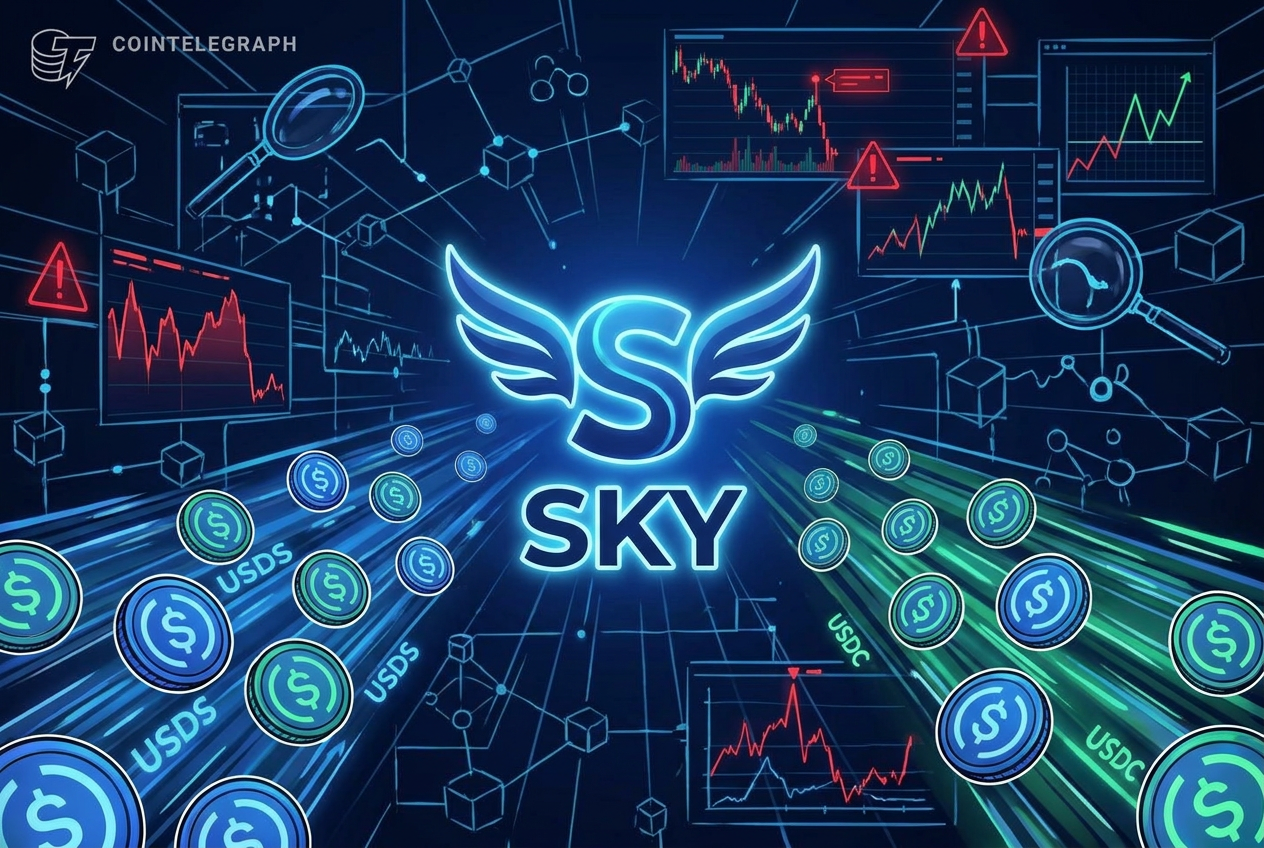
On Thursday, an investigation by crypto risk analytics firm Inca Digital found that Sky (formerly MakerDAO)’s Peg Stability Module (PSM) processed $518 million in transactions involving wallets linked to illicit activity, covering 422 addresses associated with hackers, phishing operators and sanctioned entities, of which $101.9 million was directly tied to North Korean hackers. Within 10 days after the 2025 Bybit hack, related wallets converted $91.5 million in assets via the PSM. Sky’s PSM currently holds around $2.7 billion worth of USDC in a single Ethereum address. If Circle blacklists this address at law enforcement’s request, all funds may be frozen, disrupting the redemption and peg stability of DAI and USDS. The Sky Frontier Foundation responded that the relevant transactions do not prove all the funds were stolen assets. The amount accounts for less than 0.06% of the PSM’s cumulative trading volume exceeding $930 billion, and nearly all transactions were routed through third-party aggregators instead of Sky’s official website with wallet screening controls.
On Saturday, Sky Protocol stated that on November 19, users swapped more than $2 billion worth of USDS for USDC via the Peg Stability Module (PSM), marking one of the largest single-day outflows for the module to date. The swaps maintained a 1:1 peg throughout the process, and the USDC balance within the module never fell below $800 million. Sky Protocol noted that the protocol’s approximately $9.3 billion in collateral consistently exceeds the circulating supply of USDS and DAI.
In response to CoinDesk’s report alleging the PSM handled illicit funds, Sky Protocol cited reviews by risk analytics firm Block Analitica, stating the $518 million of transactions covered in the report spanned five years and made up less than 0.06% of the PSM’s cumulative volume of over $960 billion, with roughly two-thirds occurring on the old MakerDAO PSM. Most flagged transactions were routed to the PSM via aggregators. Some links to North Korea-associated addresses were established based on multi-hop fund tracing, and the wallets in question might belong to unrelated third parties.

Citește originalul pe Wu Blockchain
Mai multe știri