


Policy Monsoon Hits the Brakes: Where Is the Crypto Space Heading in the Post-Trump Era?
With the midterm elections settled and the political winds abruptly stilled, amid fading regulatory tailwinds and the "garbage time" of two-party contention, the crypto industry faces a pivotal cyclical test: shifting from policy arbitrage to genuine business capabilities.
Author: Zuoye Waiboshan
MAGA’s red winds vanish like a cup of tea, while Texas’s nightly rain stays blue for a decade.
The dust has settled on the midterm elections, and Trump has entered the lame-duck phase ahead of schedule.
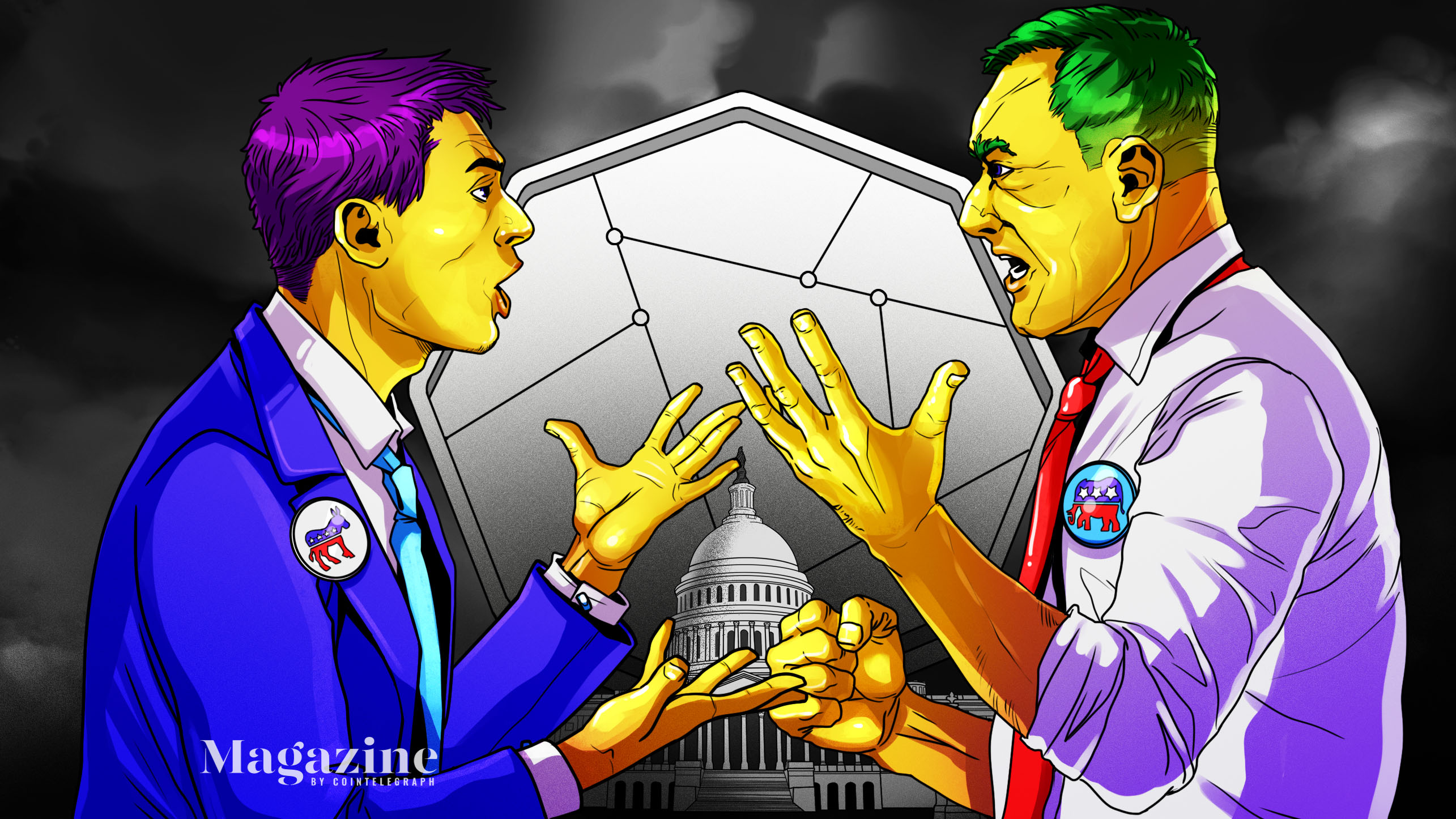
Republicans always enter the arena as rebels, yet they are invariably co-opted by the establishment, just like the Tea Party in 2010 and MAGA today. Promises were once made to go to war with the Deep State, but now the goal is to sit down with Democrats and join hands in governance; Trump has officially entered garbage time.
The Democrats are already sharpening their knives: Warren plans to re-examine the pardon procedures for CZ, and Trump family member WLFI is also on the list; meanwhile, industry insider Coinbase has ironically stalled crypto legislation. Those who bet on compliance over the past year now face mockery from wild finance.
The bull run starting on August 20 peaked with Robinhood’s Memes and ended with the Binance hack, as the final window for Perps to comply with U.S. regulations snapped shut, bringing the monsoon to an abrupt halt.
How long will the red flag continue to fly? Where is the post-Trump era crypto market headed?
Binance Time: Monopoly Is a Predicament
Countless distant lands and countless people are all interconnected with me.
Sometimes the dead are more useful than the living.
After Lindsey Graham, a staunch supporter of Ukraine and Israel, passed away suddenly in July, his sister Darline assumed the remaining Senate term and received Trump’s strong backing during these midterm elections. Trump swiftly leveraged this moment, pressing the Senate to pass the “Clear Bill” in remembrance of Lindsey.
This is genuinely surreal. Lindsey was never even a member of the Senate Banking or Agriculture Committees, and had even joined forces with Democratic crypto-skeptic Warren in 2023 to demand tighter regulations. Now, a pro-regulation deceased figure is being used to push a pro-crypto bill.
Then the hand played out badly. Darline lost her race in South Carolina, a state where Republicans had remained unbeaten for 30 years, proving that Trump’s endorsements no longer hold weight; the Democrats immediately countered, targeting CZ directly, using the procedural legitimacy of the pardon as their entry point.
Binance stands between China and the U.S., while CZ balances between two parties, constantly facing questioning over his stances. Could it be that CZ truly is a genius, foreseeing Trump’s decline ahead of time?
Against the broader political backdrop, whether it’s a $6 billion hack or a single-day outflow of $5 billion, these are merely small figures compared to $170 billion in assets. The real question is how long Binance can continue to dominate the crypto space.
Monopoly is not inherently evil; it resembles more a hallmark of an industry maturing. Everyone follows identical playbooks, and strategies across platforms are highly homogenized. Whether VCs, exchanges, or projects, what they bring to the market boils down to a few major categories: Perpetual futures, prediction markets, Memes, and stablecoins. Then comes the points race to TGE, ultimately ending with project rug pulls, leaving retail investors forgetting everything.
Fig: Monopoly is a predicament
Since the approval of spot Bitcoin ETFs in January 2024, crypto logic has rapidly become homogenized. Distinct sectors are fading away, leaving only unfinished gaps.
If mapping its basic architecture, it can be broadly divided into four phases:
Phase 0: Ignite project-level hype to attract capital for trading or investment, such as in October 2025 when nof1 launches six AI large models on HL to trade live contracts, or the October 2026 PaperTrade scandal where losses were swapped for tokens;
Phase 1: If a project successfully ignites market sentiment, it must then move into actual operations. Typically, after entering Phase 1, marketing tactics like points races are deployed to attract sustained capital inflows through potential token airdrops;
Phase 2: If a project survives the capital volatility post-token launch, it may become a key player in a specific sector of the crypto industry. At this stage, the token must align the interests of the protocol, the management team, and token holders—such as HYPE’s continuous buybacks combined with the team locking their own tokens. Conversely, ongoing conflicts between Aave Lab and its DAO serve as a negative example;
Phase 3: Once interests among all stakeholders are smoothly aligned, the final hurdle remains: regulation. The classic example is Binance’s CZ serving his sentence alongside massive fines. Success here essentially guarantees monopoly profits.
Different products are distinguished only by purchasing power; Shaxian snacks and Starbucks differ merely in unit price, not in product or image. PumpFun and GMGN both build cross-chain bridges, Uniswap absorbs liquidity from Curve and 1inch, socialization pioneered by Fomo is becoming a trend, one-off plays like PaperTrade emerge, and CEXs are racing toward ultra-fast broker-like homogenization.
These are all opportunities within the cracks. There are no longer new assets being created, nor new issuance methods—all are mere shelf-product combinations.
Summer of Security: The Steep Cost of Abandoning True Innovation
Abandoning true innovation comes at a tremendously high cost.
The Aug. 20 attack marks not only the beginning of this mild bull run but also the origin point for frequent security breaches like cold wallet hacks and exchange thefts. With industry structures growing increasingly rigid, empowered by AI, hackers can now fabricate wealth opportunities faster and in greater batches.
Fig: Security incidents also began in August
During periods of rapid innovation, users may tolerate short-term unease, but in an industry maturity phase, failing to achieve safety levels comparable to TradFi means extra returns cannot justify potential risks.
Predictably, from now until 2028, crypto users will continue to drain away, and the existing capital in the crypto circle will revalue all types of crypto assets.
After reinstating withdrawals, Binance launched high-yield deposit campaigns to restore the asset coverage ratio damaged by the hack. This is effectively an alternative expression of socializing losses. While Binance’s dominant position allows for rapid recovery, it struggles to attract external capital influx solely through these measures.
In other words, Binance is fighting to capture the existing user base of other CEXs. This battle represents cutthroat involution and repetitive behavior, offering no path to the future we desire.
The Douyin era instilled fear in ByteDance, while Binance’s era leaves crypto uncontrollable. In what form will decentralization actually become reality? More seriously, it forces us to confront our inner doubts: if Binance falls, will we witness an on-chain resurgence, or plunge into the lifelessness reminiscent of the stamp and coin collectibles market?
Politics operates like a perpetual contract. Republicans are positioning around Vance, while Democrats are sharpening their knives against the wealthy. Peter Thiel guessed the direction correctly, fleeing early to Latin America (a spiritual white enclave). Musk spent $400 million to no avail, yet they all still hold a future.
Meanwhile, crypto must pick up the tab for Binance right now.
The U.S. Regulatory Framework: Who Pays for Institutional Co-optation
"That monsoon swept so hollowly, as if everything in the world would simply disappear."
The distance between crypto and the center of the era is shrinking. Although not quite reaching AI’s status as the absolute focal point of this election cycle—with data centers grabbing water and power, and AI sparking job displacement waves—crypto, as the future of finance, has taken root firmly in reality.
Rushing ahead of the midterm results, perpetual contracts complied with U.S. standards. On a broader scale, the U.S. has assembled a nearly complete regulatory framework. Over the next two years, compliant firms will execute a "board and lock the door" market strategy: because I’m compliant, you’ll use me.
This is fundamentally a barrier to market entry and certainly won’t become a utopia for libertarians. We focus on emerging opportunities within the cracks: better to mint Memes than become Goldman Sachs.
Fig: U.S. Regulatory Framework
One can already sense the widespread anxiety. From KOLs complaining about declining traffic to fierce competition among exchanges for new users, all indicate that the CEX-dominated era is collapsing rapidly. American exchanges may lag in technology, service, and products, but they excel in compliance. Countless law firms and former officials trapped in revolving doors, eagerly waiting for opportunities, are poised to devour the sweat and blood of new money.
"Goods are no longer direct products of labor; people no longer understand the production environments or manufacturing processes behind them. Commodities presented before people grow increasingly alien and magical, marking society’s gradual descent into commodity fetishism."
Yet retail investors cannot resist. People have detached themselves from the internal mechanics of project development. Public chains, tokenomics, and project teams—combined with increasingly complex technologies and growing numbers of participants—make it impossible for anyone to grasp every detail. Even with AI, we must ask ourselves honestly: has it enhanced information transparency, or merely enriched the filler material? Ultimately, we just click "Approve" down the line, pretending we understand everything.
Acknowledge reality: it is essentially impossible today to wait patiently for Bitcoin by sticking with a project for a decade. You must act quickly, decide your participation stake, or risk being shorted by the market.
They arrive like storms and vanish like dust.
The Post-Trump Era: Shifting Mainlines in the Crypto Market
Fig: Mainlines of the Crypto Market
Taking reference from the universally recognized most volatile past bull run, the crypto industry since 2021 has averaged two to three market-level rallies, five to seven sector-level trends, and roughly ten project-level hotspots each year.
But we must acknowledge that this technological cycle started with market hotspots like Ethereum’s transition to PoS, subsequently spawned several tracks including ZK, L2, and LST/LRT, absorbed tens of billions in VC funding from firms like a16z, gave birth to hundreds of projects, peaked in 2024, and we are still in its tail-end phase today.
Moreover, since the 2024 spot Bitcoin ETF approvals, crypto-native strategies spanning ultra-long cycles and massive project pipelines are increasingly yielding to rapid tribrid projects like $TRUMP: combining full-market hype, meme track dynamics, and single-project focus.
And since 2025, only the stablecoin track has attracted fintech capital. Even privacy narratives popular in the West, such as those surrounding Zcash and Zama, have consistently failed to convince the Asian market to buy in.
Ultimately, 2026 saw no market-level, industry-wide, East-West crossover hotspots. Only Robinhood capitalized on Memes and crypto-stock pairings to harvest crypto retail investors harboring illusions about the U.S. stock market.
As Trump becomes a lame-duck president, crypto policy tailwinds pause temporarily. From wild finance’s perspective, the sovereign nation narrative also concludes. We must return to fundamental innovation: how to replace fiat currency with cryptocurrencies and connect the world.
The future crypto desires cannot be delivered by either red or blue governments.
Final Reflections: Red and Blue Governments Cannot Deliver Crypto’s Future
"Money originates from social relations, and politics is society's representative of violence."
From the elegy of rural folks to the MAGA wave sweeping through the Deep State, Trump finally completed his institutionalization in his second term. Meanwhile, crypto’s most fringe innovation, Memes, unexpectedly allowed the Trump family to amass wealth they never dared to hope for.
Across borders, similar patterns repeat. That crypto could stand shoulder-to-shoulder with AI to witness the complete rise and fall of the most radical political forces is itself the strongest proof of its vitality. Under the dual blows of the Binance hack and Trump’s lame-duck presidency, the tail end of 2026 may still harbor a sector-level or even market-level opportunity.
This approach embodies both rigid conservatism and contrarian bottom-fishing mentality. Peter Thiel fled before the midterm elections, whereas in 2016 he chose to dive straight into Washington.
Leia o original em Techflowpost

 BTC
 ETH