Zcash Devs Eye 20-Second Blocks Days After Major Network Overhaul
 ZEC
Zcash developers have proposed reducing the network’s target block interval from 25 seconds to 20 seconds under the draft Network Upgrade 7.1.
Fő pontok
- Developers proposed cutting Zcash’s target block interval to 20 seconds under draft NU7.1.
- NU7 retired Sprout on NU7, permanently freezing 12,226 ZEC ($16M) while ZEC rallied past $1,380.
- The NU7.1 proposal remains open for Zcash community discussion and governance voting.
Zcash Developers Propose 20-Second Block Times
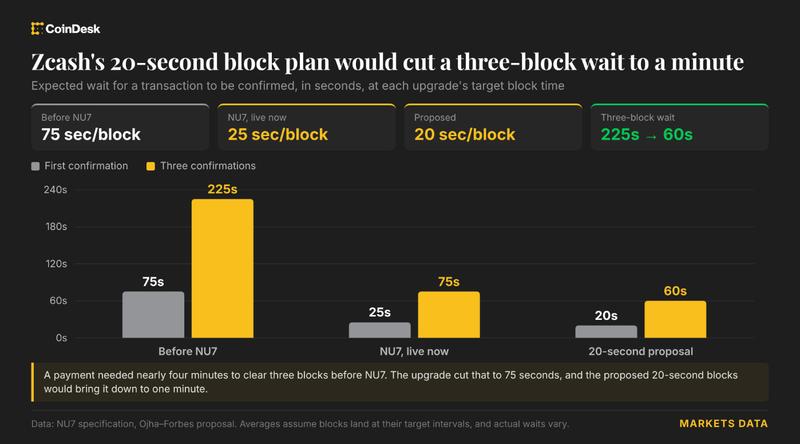
Zcash developers have proposed reducing the network’s target block interval to 20 seconds, just days after a major upgrade cut block times to 25 seconds. The latest proposal aims to accelerate transaction confirmations while preserving Zcash (ZEC)’s existing issuance schedule and supply cap.
The proposal, published for community discussion on the Zcash forums, targets inclusion in the upcoming Network Upgrade 7.1 (NU7.1). The proposal follows the successful activation of Network Upgrade 7 (NU7), which introduced several structural changes to Zcash, including faster block production, a long-term network security reserve and the retirement of its original Sprout shielded pool.
The upgrade reduced Zcash’s target block interval from 75 seconds to 25 seconds and introduced the Network Sustainability Mechanism (NSM), developed by Shielded Labs. The mechanism redirects 60% of transaction fees to a long-term reserve designed to bolster network security as mining subsidies decline, beginning around 2031.
The upgrade also retired the legacy Sprout pool by discontinuing version 4 transactions, permanently freezing approximately 12,226 ZEC, valued at roughly $16 million, associated with lost or abandoned keys.
Following activation, ZEC experienced significant price volatility, initially rallying from $1,120 to more than $1,380 before retreating 7% to 9% to a range of $1,260 to $1,315 amid profit-taking and the unwinding of leveraged positions.
Latency and Action Limit Adjustments
Despite the recent overhaul, Zcash developers are already pursuing further improvements to transaction confirmation speeds. The latest draft proposes an additional 20% reduction in thetarget block interval, which would increase expected block production by 25%.
According to the proposal, the primary objective is to reduce transaction latency, particularly for applications requiring rapid confirmations. These include point-of-sale payments, cryptocurrency exchange deposits and cross-chain swaps, where shorter confirmation times could improve the user experience.
The proposed changes would not affect Zcash’s daily issuance schedule or its 21 million ZEC supply cap. Instead, block subsidies and time-dependent parameters, including difficulty adjustment windows, would be scaled proportionally to accommodate the faster block schedule.
Developers have also proposed reducing shielded action limits to prevent the increased block frequency from placing excessive synchronization demands on light wallets and network nodes.
Specifically, the draft calls for scaling certain limits established under ZIP 218 to four-fifths of their current levels, reducing the global shielded action budget and relevant Orchard and Ironwood action limits from 330 to 264 per block.
Meanwhile, the existing 2 MB block size limit would remain unchanged. At maximum block utilization, the proposed interval would imply a theoretical peak data-processing rate of approximately 100 KB per second.
Although reducing Zcash’s target block interval to 20 seconds could accelerate transaction confirmations, it also raises concerns about higher orphan block rates resulting from tighter block propagation windows. The rapid succession of upgrades could also place additional operational demands on miners, exchanges and node operators.
However, stress tests and post-NU7 data indicate lower orphan block rates than before the upgrade, partly due to optimizations in node implementations such as Zebra and Zakura. Nevertheless, risks associated with heavy mainnet traffic remain.
Unlike NU7, which introduced major structural changes, NU7.1 focuses primarily on reducing transaction latency without altering Zcash’s monetary policy. Its implementation nevertheless remains subject to community review and governance polls.
Olvassa el az eredetit a Bitcoin.com oldalon