Bitcoin's losing streak is second-longest ever, and some observers see more downside
 BTC
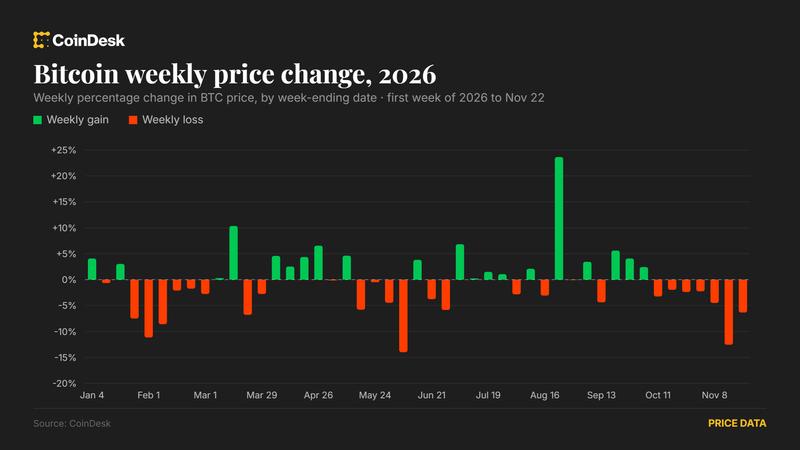
Bitcoin has fallen for seven straight weeks, its second-longest weekly losing streak on record.
The bearish run began in the week of Oct. 5 and took the price from about $86,500 to $61,100 by Nov. 22, a drop of 29%, according to TradingView data going back to 2009. The price fell to as low as $55,500 on Saturday before recovering to over $61,000 by the end of Sunday.
The decline unfolded as investors yanked billions of dollars from U.S.-listed spot bitcoin exchange-traded funds (ETFs). These funds are now down $3.77 billion in net outflows for the year, according to data source SoSoValue.
The only longer streak of weekly bitcoin price declines occurred in 2022, when BTC fell for nine straight weeks and lost 37% through late May as the collapse of the Terra ecosystem rattled the market. The third-longest came earlier this year, a six-week slide from mid-January to late February that cost 30%.
Several widely followed experts say they expect prices to remain under pressure for some time, but disagree on how deep the drop could go.
Michael Terpin, author of the 2024 book "Bitcoin Supercycle," sees a bottomforming close to current prices. In a blog post, he noted that the Crypto Fear and Greed Index, a gauge of market sentiment, dropped to 6 out of 100, below the reading of 12 it hit after crypto exchange FTX collapsed in 2022.
"When there are no panic sellers left, the price eventually has to go up," Terpin wrote.
Even so, he sees odds "approaching 50/50" that bitcoin bottoms in the low $50,000s or high $40,000s, and puts the chance of a drop to the low $40,000s at about 10%. He forecasts the price will stay below the 200-week moving average, near $75,000, until at least March, as it did after past bottoms.
Bloomberg Intelligence strategist Mike McGlone predicted far deeper losses. He described crypto's bear market since October 2025 as a preview of a broad decline across U.S. stocks, gold, commodities and Treasury yields, and expects most tokens that track nothing, such as dogecoin , to fall toward zero.
"Roughly $10,000 Bitcoin is a good gravity-pull pivot to stop out some of the silliness of expecting a space with unlimited supply to outperform," McGlone said in an X post titled, “The Everything Bubble Is Bursting.”
He warned that sharp rebounds, like bitcoin's climb from about $58,000 in June to roughly $86,000 in September, could still come along the way. "Typically gotta keep false hope alive to feed the bear," he said.
For bonds, McGlone takes the opposite view. Today's yields are the highest in about 30 years, and he sees them as a buying opportunity.
"The highest US Treasury yields in about three decades will be looked back upon as the gift of 2026 for investors," he said.
Other observers are holding off on calling a direction, pointing instead to the Federal Reserve as the trigger for bitcoin's next big swing. Traders still expect the U.S. central bank to raise interest rates by 25 basis points next month, followed by two more increases in January and March. These expectations could be influenced by Wednesday’s core PCE data. Stay alert!
What’s trending
- Market rout kills 50 basis points December Fed rate hike bets (CoinDesk): The relationship between financial markets and expectations for Fed tightening has come full circle. As markets slide, traders are rapidly scaling back bets on a larger December rate increase.
- Bitcoin sold for $17,000 on Kraken's Canadian dollar market, and the trades stand (CoinDesk): Bitcoin changed hands for as little as C$24,250 ($17,000) on Kraken early Saturday after the exchange's Canadian dollar order book broke down overnight.
- Treasury yields jump as stock futures rebound, investors await New York Fed President Williams speech(CNBC): U.S. Treasury yields rose early on Monday, partially unwinding price action seen at the end of last week, as stock futures pointed to a strong rebound on Wall Street and investors look ahead to comments from John Williams of the New York Fed.
- U.S. futures rally as AI rout pauses, Asian authorities prop up stocks (Reuters): U.S. stock futures rose on Monday while authorities in Asia moved to support markets after last week's wipeout in AI-linked stocks sparked a global selloff in riskier assets.
Today’s signal
U.S. spot bitcoin ETFs: Weekly net flows. (CoinDesk, SoSoValue)
Spot bitcoin ETFs in the U.S. registered a net outflow of $1.79 billion last week, a level not seen since July.
The fourth straight weekly exodus points to a rapidly declining institutional appetite for the cryptocurrency, as evidenced by negative year-to-date flows.
Most analysts cite renewed inflows as a necessary condition for a sustained price bounce in the largest crypocurrency.
अधिक समाचार

Bitcoin rebounds from 2-year low as Wall Street futures recover