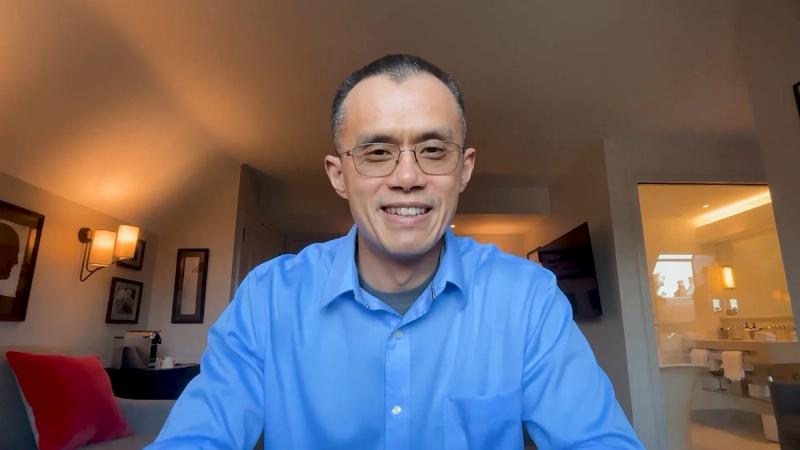

Just two days ago, Changpeng Zhao answered 19 questions at Oxford | Live Coverage
 CZ
Changpeng Zhao responds to Binance's $6.34 billion security incident at the Oxford Union, and discusses AI, stablecoins, and the Chinese market.
From the $6.34 billion security incident to stablecoins, artificial intelligence, the Chinese market, and life choices
In December 2014, 12 years ago, the year before I decided to start my own business, I had the fortune of meeting He Yi, who is now regarded as the leading female executive in the industry.
That same year, He Yi and Changpeng Zhao met for the first time. At the time, Zhao worked at Blockchain.info, while He Yi was at OKCoin.
June 2014: At He Yi's invitation, Zhao joined OKCoin as CTO.
2017: Zhao founded Binance and subsequently invited He Yi to join as a co-founder.
Time flies. Nine more years later, on November 3, 2026, I was invited to the Oxford Union Society to attend a live interview with Zhao Changpeng.
The Oxford Union Society, founded in 1823, is one of the oldest and most influential university debate societies globally. Adhering to traditions of free speech and open discussion for over 200 years, the society has hosted numerous world leaders, international statesmen, Nobel laureates, scientists, entrepreneurs, and cultural figures for speeches and debates. It has long become a pilgrimage site for public speaking and exchange of ideas with international renown.
The wind in Oxford that day was fierce and cold. In the morning, I attended an Oxford University debate centered on Zhao’s new book 《Binance Life》 (Freedom of Money). Even a large bowl of beef noodles beside St Peter College at noon couldn’t fend off the chilly afternoon gusts. By 4 PM, I had already tucked myself into the debate club's bar with a whiskey to await Zhao’s arrival, and a long queue formed by around 5 PM.
At 6 PM exactly, Zhao stepped into the Oxford Union, where the main hall was already packed with hundreds of attendees eager for the event.
On October 29, Binance had just experienced a major cybersecurity incident. According to the investigation update released by Binance on November 3, the incident involved approximately $6.34 billion in digital assets; as of the disclosure, about $2.85 billion in related assets had been frozen or intercepted. Binance stated it had provisioned sufficient funds to cover the losses and would gradually replenish the affected assets. This made the event highly significant: possibly Zhao’s first face-to-face engagement with such a large audience following this recent major incident.
Thus, the fully English interview at the Oxford Union immediately got straight to the point: After such a major error, why should users still trust the platform? Over the next hour, the discussion gradually unfolded, covering cybersecurity, entrepreneurial mission, global finance, artificial intelligence, stablecoins, and the Chinese market. During the Q&A session, quantum computing, founder credibility, marriage choices, and tokenization of traditional assets were raised. The content and depth far exceeded the August 2026 interview in Hong Kong.
Below are 19 questions posed during the event, along with Zhao’s key responses, arranged in chronological order.
01. Why accept the Oxford Union's invitation? Zhao considers the Oxford Union to be a place that truly embodies the spirit of Freedom of Speech. The industry Binance operates in is, to some extent, controversial. Binance focuses on freedom in another domain: Freedom of Money. This is actually the title of his latest autobiography. Freedom of speech is crucial as it is the necessary foundation for realizing almost all other freedoms. Looking back at the past 200 years of human civilization, we find that the concept of freedom has continuously evolved. From abolition of slavery and personal liberty, to freedom of speech, press, and information. Now, we are entering a new phase—Freedom of Intelligence. This is not merely a possibility; Zhao believes it is inevitable. Therefore, being here to discuss these issues “is an honor for me. This place is essentially where different concepts of freedom converge.” 02. Following such a severe hack, can Binance still reassure its users? Question Focus: Facing this major security breach, how does CZ plan to respond to Binance users and the public? Zhao first acknowledged that the attack exposed obvious shortcomings in Binance's security and operations. In his view, regardless of how complex the hackers' techniques were, any attack typically has multiple preventable measures beforehand, so one cannot dismiss the platform's responsibility by claiming the attack was too advanced. However, he emphasized that Binance's response afterward merits at least two points of approval: first, timely communication of progress with the outside world shortly after the incident; second, the platform's commitment to covering user asset losses itself. He linked the latter to the user protection principle established when he founded Binance, arguing that a centralized exchange must bear responsibility during a crisis rather than forcing users to pay for internal vulnerabilities. He compared the blockchain's publicly verifiable nature with the disclosure practices of traditional financial institutions: on-chain fund flows can be tracked in real-time by external analytics firms, and sometimes third parties identify anomalies even earlier than the platform internally. His judgment is that while this transparency may amplify the immediate impact of a crisis, it is also the reason the system can withstand public scrutiny. The core of this question is not “Binance is absolutely safe,” but rather CZ's admission of mistakes alongside an emphasis on emergency transparency and mechanisms for covering user losses. Additionally, “Short-term wise, AI has a double-edged effect. But in the long run, I firmly believe that artificial intelligence will make the entire financial and cryptocurrency systems much safer. We are merely in a transitional phase.” 03. Can you guarantee that such an attack will never happen again? Question Focus: Since you believe attacks are preventable, what specific guarantees can the platform provide? CZ did not promise 100% safety. He believed that similar attack vectors should be thoroughly investigated and plugged, but anyone claiming a complex information system can remain immune to attacks forever is unrealistic. Based on his live explanation, the attackers likely spent about five to six months preparing, first attempting to infiltrate the company via fake recruitment and social engineering, then using AI to accelerate system understanding. He specifically pointed out that failure to strictly execute certain basic operational security procedures is a problem that should never appear on a major trading platform. “There is a fundamental asymmetry in cybersecurity”: The difficulty lies in the fact that attackers only need to find one entry point, while defenders must scan all possible entry points. As AI rapidly increases attack efficiency, defenders must also strengthen device security, access permissions, internal processes, and behavioral anomaly monitoring, and collaborate with AI companies, cybersecurity experts, regulators, and law enforcement. Therefore, his attitude toward the future is not to guarantee “no more incidents,” but to drive the industry from reactive remediation to stronger proactive defense. Regarding cross-institutional collaboration triggered by this attack, he noted positive changes, but recovery efforts are still ongoing. 04. Why did it take until approaching 40 for you to view blockchain as your entrepreneurial mission? Question Focus: Why does CZ view Binance as a venture worth long-term commitment? CZ believes that a startup lasting many years cannot rely solely on profit motives. When someone first enters the workforce, they usually consider livelihood first, then family; finding a true mission to commit to long-term may take longer. For him personally, this process was equally not instantaneous. Reflecting on his birth in China, upbringing in Canada, and subsequent work across different countries, he believes these experiences reinforced his emphasis on personal liberty. The internet made information dissemination more open, but he missed early internet entrepreneurial opportunities. Upon encountering blockchain, he gradually came to believe that this technology could bring similar transformations to capital flows and economic participation. He also noted that many profoundly impactful technologies in history faced intense controversy in their early stages. “For instance, when the printing press first emerged, it was restricted or even banned in many places. Later, freedom of the press was also a highly controversial topic that sparked extensive debate. Technologies capable of profoundly altering society usually undergo similar processes.” In his view, the volatility and skepticism the blockchain industry has endured do not necessarily negate its long-term value. His entrepreneurial narrative thus centers on one word: mission—the belief that technology can alleviate certain real-world limitations. 05. With banks and fiat currency, why is cryptocurrency still needed? Question Focus: If the existing financial system can already facilitate transactions, what new problems does blockchain actually solve? This was one of the richest segments of the interview. CZ first emphasized financial service accessibility: living in a mature financial system like the UK, people might struggle to grasp the difficulties certain regions face with opening accounts, transferring funds, or making cross-border payments. For populations lacking adequate bank coverage or facing high cross-border payment costs, mobile wallets and blockchain payments offer an alternative. He then discussed purchasing power and wealth preservation. In high-inflation environments, people seek tools to protect assets, though he admitted not all cryptocurrencies are suited for this role. “Those who successfully invested early in major tech companies often enjoyed disproportionately high returns. But they bore significant risks initially. Therefore, some individuals becoming wealthy through cryptocurrency is hardly an unexplainable phenomenon.” A third value comes from cross-border payments, and a fourth from trading hours and global accessibility of financial markets. He believes friction between national financial systems persists, while on-chain payments and trading possess the technical potential for 24/7 operation. Finally, he extends this convenience to global asset allocation: investors from different countries should ideally have easier access to quality financial assets across various markets. However, this is an argument about technological potential rather than a proven conclusion that all crypto financial services outperform banks. Practical applications still need to address fees, compliance, custody, and consumer protection. 06. How long until the global financial system fully adopts blockchain? Question Focus: What timeline will the technology face moving from the fringe to the mainstream? Where are the bottlenecks? CZ used the “S-curve” of technology adoption to describe the likely path: slow initial growth, acceleration past a certain threshold, and slowdown upon maturity. On-site, he gave a rough personal estimate: reaching preliminary widespread adoption might take five to ten years, the intermediate phase could span ten to fifteen more years, and final conversion for remaining users or institutions could be extremely protracted. These figures are not model-verified industry forecasts. He believes shifts in the U.S. stance on digital assets will influence regulatory discussions elsewhere. However, harder to change than policy positions may be the massive financial infrastructure: existing banking systems, internal workflows, compliance mandates, and technical interfaces aren’t easily overhaulable. Even as new platforms grow rapidly, they may still face hurdles accessing traditional banking services across different regions. Another layer of resistance stems from government control over monetary policy and capital flows. “Governments are not always the most efficient entities for solving economic problems. In many cases, excessive intervention can create new issues.” CZ leans toward a freer global economic system but acknowledges the crypto industry still faces security, fraud, and governance challenges, making it unrealistic to demand nations liberalize overnight. He offered not a precise year, but a judgment of “long-term, non-linear, simultaneous advancement of institutions and technology.” 07. How will AI reshape the cryptocurrency industry? Question Focus: Are AI and cryptocurrency two parallel hotspots, or will they form tangible commercial connections? CZ first discussed software development. He mentioned using natural language-driven AI coding tools(Vibe Coding), noting a noticeable recent improvement in technical capability. Startup teams previously expended immense effort writing code and building systems; now that task is gradually becoming easier. Competitive advantage may shift from pure coding skills to product design, market insight, and problem-solving. For the crypto industry, AI can accelerate product development, system improvements, and security analysis, and may also drive cryptographic algorithm updates. However, he believes the more noteworthy aspect is the massive volume of micropayments (Micropayments) that may occur between AI agents in the future. As agents act on behalf of users to find services, complete tasks, and settle automatically, frequent machine-to-machine payment demands will emerge. For example, a minor software development task might be automated in the future, with the system matching executors, verifying results, and disbursing compensation. If tens of thousands of such transactions occur daily, low-cost, digitally native, programmable payment infrastructure will be required. CZ did not assert that any existing public chain will inevitably win. His view is that AI may generate new payment demand, and blockchains and stablecoins have opportunities to participate in fulfilling it. 08. Will compute power, data centers, and energy keep pace with AI expansion? Question Focus: With rising software and model demands, can the physical world supply enough power, hardware, and infrastructure? CZ remains broadly optimistic. One reason is capital investment: global tech firms and institutional investors are pouring massive resources into AI and compute infrastructure, which he believes will accelerate iterations in hardware, data centers, and power technology. He envisions solar facilities and data centers potentially occupying more land in the future; as compute demand grows, the scale and form of energy systems could see significant shifts. Nevertheless, he did not deny resource bottlenecks, such as short-term supply lagging behind expansion speeds for certain materials. More importantly, he disagrees with projecting decades-long technological boundaries solely on current equipment architectures. “If AI can forge new algorithms for our industry, it is entirely capable of helping develop novel solutions for energy, materials, and computation.” This reflects an optimistic assessment of technological progress, not a guarantee that future grids, chips, or material supplies will be worry-free. 09. When AI enables everyone to start a business, will it result in a flood of useless products? Question Focus: If trial-and-error and programming are handled by AI, will young entrepreneurs still acquire real skills? The moderator shifted the question from technology to education, citing unproductive products in recent startup waves and worrying that lowering development barriers via AI would only flood the market with similar projects. CZ responded that learning fundamental principles remains crucial. AI can draft programs, but it cannot allow entrepreneurs to completely abandon judgment, validation, and systemic understanding. Blindly trusting AI-generated code for critical systems is especially dangerous. He gave examples: in the future, one model could write code while another cross-reviews it, or multiple agents could iteratively verify outputs. He also proposed a further vision: machines might cease generating human-readable source code, instead producing code closer to low-level execution formats directly. In other words, he does not consider “writing every line of code” as the indispensable skill for future entrepreneurs. Understanding product goals, grasping basic logic, and establishing reliable verification mechanisms remain essential. “I believe what will truly matter in the future is understanding fundamental principles, rather than demanding everyone master every specific technical detail.” 10. Why has crypto enthusiasm cooled? Why are governments cautious? Question Focus: Why isn't public discourse as fervent as 2020–2022? Why haven't countries universally embraced it? CZ offered a counterintuitive explanation: “When a technology matures and becomes social infrastructure, people often stop discussing it specifically.” Internet protocols, mobile networks, or roads are part of daily life yet rarely dominate headlines. Thus, declining media hype doesn’t necessarily mean lost technological value; it may simply reflect gradual normalization of applications. He also noted AI has drawn massive capital and media attention, objectively shifting the tech sector’s focal point. Regarding government stances, he emphasized differing national interests. For instance, USD stablecoins allocate partial reserves to U.S. Treasuries, potentially boosting demand; global usage of dollar-denominated stablecoins may also extend dollar influence. This helps explain why the U.S. might recognize the strategic and financial value of stablecoins. Yet for nations enforcing stricter capital controls, the cross-border liquidity freedom brought by crypto may contradict current policy goals. CZ provided no one-size-fits-all answer nor fully resolved the moderator's concerns regarding illicit transactions. 11. Perspectives on China’s capital controls, RMB internationalization, and Hong Kong’s role? Question Focus: How should the balance be struck between promoting RMB’s international use and managing cross-border capital flows? Discussing national financial systems, CZ specifically addressed China. He sees one goal of capital controls as managing outbound capital, but investors also weigh whether future profits can be repatriated smoothly. Even when permitted, procedural and time costs may still influence cross-border investment decisions. Consequently, he pointed out the need for long-term coordination between RMB internationalization and capital flow management. However, he claimed no best policy answer, emphasizing varying national economic scales, institutional goals, and risk tolerances. Regarding Hong Kong, CZ described it as an observational “test field Sandbox” for digital asset innovation. This should be understood as his assessment of Hong Kong’s role, not a policy signal that mainland China will fully liberalize crypto trading. He specifically cautioned against market overexcitement driven by statements supporting financial innovation: “If China fully opens a certain sector, millions or even tens of millions of new projects could emerge rapidly. Some may be legitimate, high-quality innovations. Others may be scams, malicious actors, or unmanageable complications. When project volumes reach such scale, regulation becomes highly complex. Therefore, China must prudently consider how to implement opening policies.” The emphasis lies on diverse economies having distinct choices regarding opening speed and risk management, rather than simplistic “support” or “oppose” stances toward crypto. Audience Q&A Session— 12. Will the next wave of mass crypto adoption be driven by institutions or retail consumers? Question Focus: After waves like ICOs and NFTs fade, what application will bring true mass adoption? An Oxford MBA student in the audience noted that past industry growth was often driven by new concepts, whereas today’s attention increasingly shifts toward institutional finance and asset tokenization. Will massive adoption in the future be triggered by 24/7 trading, payments, or a novel consumer-grade application? CZ offered no definitive “next killer app.” He reviewed market narratives across Bitcoin, altcoins, ICOs, and NFTs, acknowledging the industry indeed lacked sufficiently compelling consumer innovation during certain phases. Currently, increasing institutional participation and traditional U.S. equities exploring tokenization are directions he deems worthy of attention; however, genuine breakthroughs targeting everyday people, especially in routine payments, may still require years to mature. He admits he cannot accurately predict which product will trigger the next growth wave. This is a rare question where CZ explicitly stated “I don’t know the exact answer yet.”“but I believe this industry will continue to produce new innovations.” 13. What exactly distinguishes CBDCs, stablecoins, and Bitcoin? Question Focus: As CBDCs advance, will they replace stablecoins or native crypto assets? CZ distinguishes these three asset classes by purpose. CBDCs are issued by central banks with sovereign credit backing; depending on design, they may feature clearer access controls, fund usage restrictions, and issuance schedules. They are not inherently equivalent to decentralized cryptocurrencies. Stablecoins are typically issued by corporate entities and mostly pegged to fiat currencies like the USD. They circulate on blockchains, suited for trading and cross-border payments, but holders must still assess issuer, reserve asset, redemption, and regulatory risks. CZ recalled that traditional banks’ historical reluctance to serve many crypto platforms actually fueled the adoption of USD stablecoins within the industry. Native crypto assets like Bitcoin, Ethereum, and BNB operate on their own networks with distinct economic mechanisms and price volatility, representing closer participation or risk exposure to their respective ecosystems rather than merely seeking stability against fiat currencies. His conclusion isn’t replacement but diversification serving different needs: ”Different types of digital assets satisfy different requirements. If you simply want to use crypto for cross-border payments, you will likely choosestablecoins today. But if you wish to invest in the long-term development of the crypto industry, you mightconsider Bitcoin, Ethereum, BNB, or other projects with long-term growth potential.“ Payments, fiat digitization, and participating in blockchain ecosystems were never mutually exclusive choices. 14. Could quantum computing eventually break Bitcoin? Question Focus: If quantum computing capabilities leap significantly, how long can current cryptographic security systems hold? CZ first clarified he is not a quantum computing expert and refrains from absolute judgments on unfamiliar technical details. He acknowledges quantum computing may challenge certain existing cryptographic algorithms and notes tech firms continually publish related research progress. But he cautions that new technologies often enable both attacks and defenses. As quantum computing advances, post-quantum cryptography research and system migration can progress synchronously. The real challenges lie in determining future quantum capability thresholds, timing for existing technology upgrades, and implementation methods. Thus, his stance emphasizes risk awareness and continuous preparation without assuming Bitcoin or the broader industry will inevitably lose its future due to this potential threat. “I won’t be overly pessimistic about the future of Bitcoin or the entire crypto industry because of quantum computing developments.” 15. Do Binance users trust the platform, or CZ personally? Question Focus: After CZ stepped down as CEO, can personal reputation and institutional credibility still be separated? This live question strikes at the heart of centralized exchanges. CZ believes trust requires long accumulation yet can be damaged quickly; an exchange accepting user assets assumes counterparty responsibilities that must be continuously verified. He emphasized that although he no longer directly manages Binance, the principle of protecting user assets should not depend on whether a founder is in office, but become part of the platform’s own systems and conduct. He also mentioned that upon observing capital net outflows decrease below his initial concerns when withdrawals resumed, he indicated subsequent capital flows improved. Nonetheless, withdrawal ratios and net inflow data are his live statements; this article does not draw independent audit conclusions from them. He believes that publicly disclosing accident-exposed flaws, though potentially awkward, helps Binance and other platforms learn lessons. For a centralized financial institution, true credibility cannot rely solely on a founder’s charisma but must rest on consistent ability to fulfill commitments. “For me, what truly matters is not whether an institution never makes mistakes, but how it resolves issues, accepts responsibility, learns from them, and moves forward.” 16. How does CZ advise young people to choose a partner? Question Focus: People often discuss how to choose business partners, but what about life partners? Following a series of serious questions on technology, finance, and security, an audience member suddenly pivoted to private life. He asked CZ how young people should choose life partners and what role a partner plays in personal career endeavors. CZ did not reply with a typical entrepreneur’s success formula. He stated that finding business partners is already difficult, choosing a life partner may be even more complex; he himself hasn’t found a standard answer applicable to everyone. He referenced his own marital and divorce experiences, acknowledging people change over time and relationships evolve accordingly. “This is genuinely a very difficult question. I don’t have a simple standard answer to offer everyone. I can only wish you all luck.” The moderator then lightened the mood, mentioning an upcoming debate union event focused on interpersonal relationships. This became one of the few moments that evening shifting from financial topics to personal life, making the on-site exchange feel notably more natural. 17. Who bears the $6.34 billion loss? Did CZ tap personal wealth? Question Focus: Where exactly did the funds to replenish user assets come from? An on-site audience member from Indonesia noted online speculation that besides Binance’s protective funds, CZ might have used personal capital to help compensate users. He requested clear clarification. CZ outlined three funding sources based on his knowledge: the SAFU User Asset Security Fund, the Futures Insurance Fund, and capital from Binance’s corporate balance sheet. He noted the SAFU fund is roughly in the billions range, with a portion utilized; he also provided approximate scales and utilization statuses for the futures insurance fund. However, these specifics stem from his live estimates and should not be treated as independently audited precise balances. He specifically distinguished between “frozen or restricted stolen assets” and “recouped funds ready for reuse.” Even if assets are traced, actual restitution may require judicial and enforcement procedures. 18. Crypto claims decentralization; why can governments still freeze or seize it? Question Focus: Does law enforcement seizure of digital assets contradict the decentralized philosophy? An audience member cited U.S. government actions targeting crypto assets linked to specific countries or entities, wondering how governments manage to freeze or confiscate them. CZ stressed he lacks full case details but explained a common mechanism: when digital assets enter regulated intermediaries like centralized exchanges, exchanges may receive court orders, lawful enforcement requests, or legal documents, necessitating restriction measures on relevant accounts and assets. Thus, the operational mechanics of decentralized networks and whether funds pass through centralized custodians/exchanges are two issues requiring separate discussion. Possessing on-chain transfer capabilities does not imply all real-world transaction pathways escape judicial jurisdiction. 19. Will tokenization of US stocks and commodities drain crypto capital? Question Focus: When traditional assets enter digital platforms, will native cryptos like Bitcoin lose liquidity? The final on-site questioner hails from China. He pondered whether traditional financial assets like U.S. equities and commodities entering crypto platforms would siphon investment capital originally destined for crypto assets. “My answer is: both yes and no.” CZ’s analysis divides into two temporal dimensions. Short-term, if the native crypto sector lacks sufficient new applications, investors may indeed divert some capital from crypto to equities or other categories; but long-term, added asset diversity could attract traditional investors who previously never utilized digital wallets, stablecoins, or crypto trading services. For instance, an Asian investor originally interested only in U.S. stocks might enter a digital asset platform via more convenient trading channels. Once familiar with stablecoin payments and platform operations, they may begin exploring Bitcoin or other on-chain assets. Under this logic, traditional asset tokenization is not merely competition for existing market liquidity; it may expand the ecosystem’s potential user base. CZ therefore emphasized that enabling broader, easier access to quality assets holds greater significance than confining users to a single crypto asset. Naturally, whether actual tokenized securities can open to international investors depends on securities laws, issuance structures, custody arrangements, and investor protections; technical tradability does not equate to unrestricted legal circulation. Conclusion: Looking at the 19 answers, what does CZ most want to emphasize? This dialogue began with Binance’s security incident but did not remain confined to “incident response.” The 19 questions reveal four interwoven threads. First, security and credibility form the baseline for financial platforms. CZ acknowledges systemic vulnerabilities and admits no one guarantees absolute safety; yet he insists that platform accountability, timely disclosure, and institutional repair following incidents are crucial conditions for centralized exchanges to maintain trust. Second, crypto’s value must return to practical utility. Financial inclusion, cross-border payments, global asset accessibility, and 24/7 trading align closer to the long-term technological direction he envisions than short-term market speculation. Third, AI may simultaneously transform supply and demand sides. It eases software development while complicating cyberattacks; future AI agents could also generate massive demand for automated machine-to-machine trading and microtransactions. Finally, technological evolution does not bypass institutional realities. From U.S. stablecoins and Hong Kong’s digital asset explorations, to China’s capital management and centralized exchanges cooperating with law enforcement freezes, industry development remains intertwined with national laws, financial regulation, and institutional governance. This Oxford Union dialogue offers no fixed timeline for crypto’s total mainstream integration, nor answers eliminating all technical and security risks. It resembles more a re-examination following a major security crisis, asking what this industry ultimately relies on to earn long-term trust. (Full view of the Union, not a photo from this event) Bonus/Behind the Scenes After the event, when telling my son about Zhao’s net worth of $114.6 billion (approx. 810 billion RMB) ranking 18th globally, my musician son exclaimed: Wow, he’s incredibly wealthy! I said: You know what? He moved to Canada at 12, started working at McDonald’s at 14, and the last time he took money from home was for his first-year university tuition...
Прочетете оригинала на Techflowpost
Още новини

 USDT

 MSTR