
A year after buying bitcoin, Czech central bank won't say what it's worth
 BTC
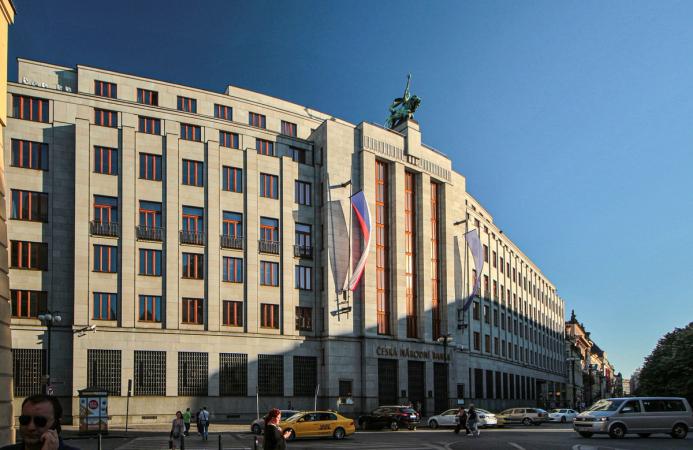
A year after the Czech National Bank (CNB) made headlines by buying bitcoin, it still won't say how much it owns, what it paid or what the investment is worth after the cryptocurrency's steep decline.
The CNB launched a $1 million test portfolio on Nov. 13, 2025, holding bitcoin, U.S. dollar-pegged stablecoins and a tokenized dollar deposit (a bank deposit recorded on a blockchain).
The purchase was hailed as a milestone for central banking. But a year later, CoinDesk has learned that the bank uses an outside custodian to safeguard its bitcoin, while its audited financial statements provide no separate market valuation of the holdings.
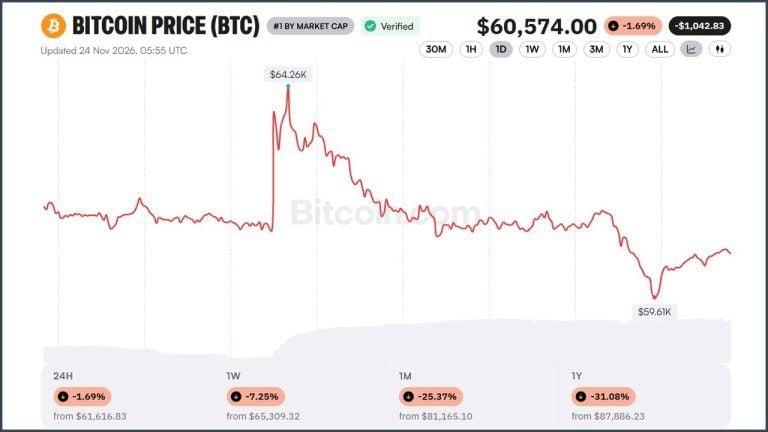
The bank's board approved the experiment on Oct. 30, 2025, when bitcoin traded at about $110,670. By the time the portfolio was announced on Nov. 13, the cryptocurrency had fallen to roughly $98,000. It traded near $61,000 on Monday, about 44% below the level at the announcement.
That doesn't establish how much the CNB has lost, as the bank has never disclosed the date or price of its bitcoin purchase, or how much of the $1 million portfolio was allocated to BTC rather than the other digital assets.
"Neither Governor Michl nor the CNB has ever commented on the price at which bitcoin was acquired," Jakub Holas, director of the CNB's communications division, told CoinDesk earlier this week.
The CNB also declined to say whether its bitcoin holdings have changed since the original purchase or whether it expects to write down their value at year-end.
"The CNB does not disclose the detailed composition of the pilot portfolio, including individual allocations, prices, transaction dates, trading venues or counterparties," Jaroslav Krejčí, a spokesperson for the bank, told CoinDesk in an email.
Krejčí said the first bitcoin purchase "was executed on a regulated foreign exchange" and that the coins are held "through external custody arrangements," meaning an outside firm keeps them (and the keys) on the bank's behalf.
The bank did not identify either company. Using an outside custodian does not mean the CNB doesn't own the bitcoin, but it does mean the central bank isn't handling custody entirely in-house.
The CNB has previously examined self-custody, in which it would manage the cryptographic keys controlling the assets, and arrangements involving external custodians. It described securing its own custody infrastructure as a complex undertaking.
The money sits in the bank's research and innovation unit to CNB Lab rather than the roughly $180 billion in international reserves managed under Governor Aleš Michl. The central bank has said it does not plan to add to the initial $1 million investment.
At cost, not market value
The bank's audited 2025 financial statements shed some light on why the value of its bitcoin investment isn't readily visible.
Note 2.25 of the statement divides the portfolio into two accounting categories. Stablecoins and the tokenized dollar deposit are treated as foreign-currency claims, while bitcoin falls under intangible assets, a category that also includes items such as software.
Note 2.17 says intangible assets are recorded at cost and specifies that digital assets are not amortized. Unlike assets routinely revalued at market prices, the bitcoin holding is therefore not automatically adjusted to reflect daily price movements.
The statements also do not separately identify the bitcoin position, its acquisition cost or its market value. They also cover the year ended Dec. 31, 2025, before much of bitcoin's subsequent decline.
That leaves a further accounting question unresolved: whether the bank would recognize an impairment if bitcoin's market value fell below its carrying value. Earlier CNB research contemplated such allowances, but the bank did not clarify to CoinDesk how it would treat a decline in the pilot portfolio.
As such, the sums are negligible for the central bank. The entire $1 million portfolio accounted for roughly 0.0006% of its assets at inception, according to the CNB.
But the experiment was designed to teach the institution how to acquire, safeguard, account for and manage digital assets. A year later, some of the most basic information about its own bitcoin investment — how much it bought, what it paid and what the holding is now worth — remains undisclosed.
Больше новостей