


Wall Street cuts Bitcoin miner price targets as newly blue Texas threatens data center boom
 BTC
 GS
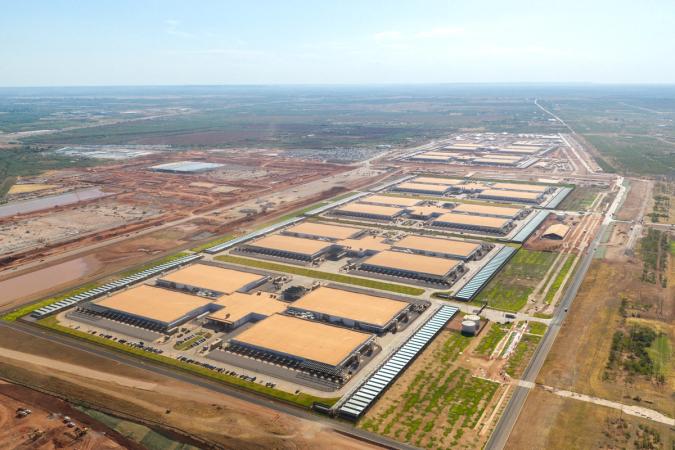
Wall Street is taking another look at the AI data center boom after Democrats swept Tuesday's midterm elections, including a surprise gubernatorial win in Texas that could hold up billions of dollars in planned projects.
For bitcoin miners that have been moving into AI, the concern is whether they'll be able to get the electricity they need to build new data centers. Those that already have power secured may be in a much better position.
Texas is where much of the concern lies.
Democrat Gina Hinojosa defeated Republican incumbent Greg Abbott, who had been heavily favored to win. Hinojosa wants to halt new data center approvals until Texas puts rules in place to protect residents from higher electricity bills and water costs.
Goldman Sachs estimates that states likely to tighten data center rules account for about 45% of planned U.S. capacity, with Texas alone making up roughly a quarter. SemiAnalysis puts Texas at nearly 30% of the capacity expected to come online in 2028, according to Bloomberg figurescited by analyst Neil Sethi.
Tech stocks initially took a hit as the election results came in. Nasdaq-100 futures fell about 1.5% overnight before recovering Wednesday morning.
But analysts don't expect the election to bring data center construction to a standstill. The bigger concern is that projects will take longer to get approved and cost more to build.
PIMCO's Libby Cantrill expects "a lot more sand in the gears," even without statewide bans, according to Sethi's roundup of analyst reactions.
Goldman Sachs economists expect Democrats in Texas, Georgia and Michigan to impose temporary pauses on new data centers while lawmakers consider tighter rules on electricity, water use and tax breaks. They don't expect those restrictions to last long, however, arguing that data centers aren't a top priority for most voters.
What it means for bitcoin miners
Bitcoin miners have spent the past two years trying to turn their access to cheap power and large industrial sites into AI hosting businesses. Texas has been central to those plans.
Bernstein senior analyst Gautam Chhugani said more than half of the power capacity held or planned by the miners-turned-AI developers his firm covers is in Texas.
Investors had expected Abbott to ease restrictions on new data centers after the election, provided developers met certain conditions. Hinojosa's victory has changed that calculation.
"We would expect the data center pause to continue and any data center potential legislation to remain in gridlock," Chhugani wrote in a research note.
That doesn't mean every miner with operations in Texas is in trouble. Chhugani said companies that have already secured power could benefit if new restrictions make it harder for other developers to get connected to the grid.
IREN IREN$21.32, Riot Platforms RIOT$15.34 and Cipher Mining CIFR$6.3960 have the most Texas exposure among the companies Bernstein covers. But all three also have approved power capacity measured in gigawatts, which Chhugani said "may be considered scarce and valuable."
Morgan Stanley made a similar distinction between projects already underway and those still waiting for approvals.
In a Wednesday note, analysts led by Stephen Byrd flagged Cipher Mining, MARA Holdings MARA$6.7480 and Galaxy Digital GLXY$14.54 as facing greater uncertainty in Texas. The bank said it would take another look at the prospects for Cipher's Colchis site, Galaxy's Helios II project and MARA's expansion plans.
Morgan Stanley sees TeraWulf WULF$11.51, Hut 8 HUT$50.12 and Applied Digital (APLD) as better placed to deal with tighter power supplies. TeraWulf has little exposure to changes in Texas regulations, while Hut 8 could benefit if developers shift projects to Louisiana.
Riot is a tougher call. Its existing grid connections at Corsicana and Rockdale could become more valuable, Morgan Stanley said, but plans to build more data center capacity at those sites could still run into trouble.
Bernstein slashes price targets
Bernstein isn't waiting to see how the new rules play out. The firm cut its price targets on seven bitcoin miners, citing tighter financing markets and uncertainty over what happens next in Texas.
"In the view of tighter financing markets and overall Texas uncertainty, we now value AI colocation business at 12x EV/one year forward EBITDA on CY30E EBITDA," Bernstein said.
In other words, Bernstein is assigning a lower value to the earnings it expects miners to generate from renting out data center space and power to AI customers.
The firm lowered its price target on Cipher Mining to $15 from $23 and IREN to $55 from $100. TeraWulf's target fell to $20 from $36, while Core Scientific CORZ$12.47 was cut to $19 from $32.
Bernstein also reduced Riot's target to $18 from $35, MARA's to $10 from $17 and CleanSpark's CLSK$6.9550 to $11 from $24. The cuts range from about 35% to 54%.
Not everyone on Wall Street sees a slowdown in construction as bad news for the AI trade.
Goldman Sachs strategist Rich Privorotsky said AI stocks had already been heavily sold ahead of the election. He thinks some companies could bring forward spending into 2027 to get projects underway before new rules take effect.
And if fewer data centers get built, the ones already operating could become more valuable.
Pershing Square also made the case for continued AI investment in its November 2 shareholder letter. The firm noted that Microsoft, Meta, Amazon and Google are expected to spend about $740 billion on capital projects this year, up from roughly $140 billion in 2023. That figure could exceed $1 trillion in 2027.
For bitcoin miners, though, the question is how much of that spending they can capture. Companies with operating sites, approved power and signed AI hosting contracts may have an advantage. Those counting on future grid connections could face years of delays.
Citește originalul pe CoinDesk
Mai multe știri



 GOOGL