

Bitcoin Mining Difficulty Has Never Stayed Below Its Peak for This Long
 BTC
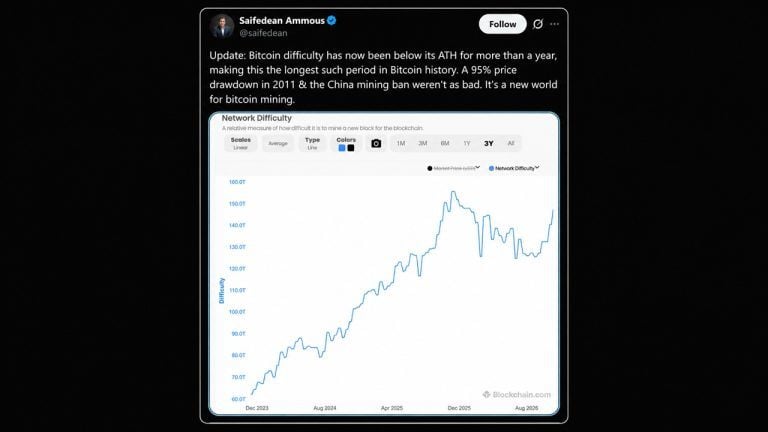
Bitcoin’s mining difficulty has now spent 374 days below its October 2025 all-time high, the longest such stretch in the network’s history, beating a record set after the 2011 crash.
Punti chiave
- Bitcoin difficulty peaked at 155.97T on Oct. 29, 2025, and has not returned there for 374 days.
- The streak beats 2011-2012’s 364 days and the 253-day gap after China’s 2021 mining ban.
- Mempool.space projects a roughly 3.7% difficulty drop around Nov. 13, pushing a new high further out.
A Record Nobody Wanted
Economist and author Saifedean Ammous flagged the milestone on Saturday, writing that Bitcoin difficulty has been below its all-time high for more than a year, adding:
A 95% price drawdown in 2011 & the China mining ban weren’t as bad. It’s a new world for bitcoin mining.
Difficulty is the measure of how hard it is to find a new block. The network adjusts it about every two weeks, or every 2,016 blocks, so that blocks keep arriving roughly every 10 minutes no matter how much computing power is pointed at the chain.
Bitcoin.com News checked the claim against Mempool.space data and found that the difficulty quotient set its record of 155.97 trillion (T) at block 921,312 on Oct. 29, 2025. Every adjustment since has landed below that mark. As of today, that is 374 days.
How It Compares to 2011 and 2021
The previous record dates to Bitcoin’s early years. After difficulty peaked on Aug. 1, 2011, it took until July 30, 2012, to set a new high, a gap of 364 days, according to the same Mempool.space adjustment history. That came during the 2011 crash Ammous referenced.
The 2021 China mining ban, which forced a huge share of the world’s miners offline, caused a shorter gap. Difficulty then peaked on May 13, 2021, and recovered to a new high by Jan. 21, 2022, about 253 days later.
This time the drop was milder but has lasted longer. Difficulty bottomed at 124.93T in mid-June 2026 after a 10.09% cut, about 20% below the peak. Bitcoin.com News covered the move at the time as mining difficulty dropped 10% to its lowest level since July 2025.
The Recovery Stalled Just Short
That said, the gap had been closing as difficulty jumped 5.92% on Oct. 16 and rose another 5.54% on Oct. 29 to 148.36T, about 4.9% below the record. The network’s seven-day hashrate also returned to 1 ZH/s (zettahash per second) in late October after nearly eight months below that level.
But the next adjustment points the other way, and Mempool.space estimates a drop of about 3.7% when the current epoch ends, roughly six days from now. That would push any new all-time high further out.
Why Miners Are Struggling
The pressure is coming from BTC’s lacklustre price action as well as from rising overheads. At press time, bitcoin is trading just under $76,000, well below the levels that made last year’s buildout pay off.
Moreover, publicly listed miners have been selling coins and moving into AI, with Bitcoin.com News reporting earlier this week that Riot Platforms sold $750 million in bitcoin while Hut 8 sold $250 million. Similarly, Keel Infrastructure dumped its entire $192 million treasury, while Terawulf and IREN bet big on AI as mining revenue continued to shrink.
Politics has added another risk to the mix because after the midterm sweep, Democrats are pushing data center limits that could hit Bitcoin miners competing for the same power.
What It All Means
A long stretch below peak difficulty does not mean the network is weaker. Hashrate is back above 1 ZH/s, and blocks are still arriving on schedule, but what it does show is that the relentless growth in mining power has hit a wall.
The next difficulty adjustment around Nov. 13 is the near-term test, and a strong rebound for bitcoin could bring miners back and help move the difficulty ratio toward a new high again.
Leggi l'originale su Bitcoin.com