

Before the Sell-Off, AI Stocks Showed Dot-Com-Level Bubble Signals: Study

Vigtige pointer
- Researchers from London Business School and the University of Cambridge put the probability of an AI stock market bubble in September as high as 97%.
- The study used artificial intelligence to analyze nearly 800,000 articles from The Economist and examined 22 historical financial bubbles.
- The researchers found that unusually intense media warnings can predict weaker market returns, despite the financial press routinely overestimating crash risks.
Researchers from London Business School and the University of Cambridge have estimated that there was as much as a 97% probability that AI-related stocks were in a financial bubble in September, before the recent sell-off wiped trillions of dollars off technology stocks.
The findings, highlighted Wednesday by London Business School, come from an analysis of 170 years of financial journalism. The researchers used artificial intelligence to determine whether the language journalists use to describe financial markets can help identify speculative bubbles before they burst.
Did you know?
You can now act on the news you read: Go long or short ANT with perpetual futures, all from your Decrypt Money Account.
September's readings were comparable to or higher than those recorded at the peak of the dot-com bubble in March 2000, after which the Nasdaq lost roughly 77% of its value.
The research, titled Crying Wolf, was conducted by London Business School finance professor Marco Grotteria and Cambridge researchers Afonso Monteiro and Constantine Yannelis.
The team analyzed 795,964 articles published by The Economist between 1843 and 2013, identifying approximately 486,000 relevant to financial markets. They subsequently extended their index through September 2026.
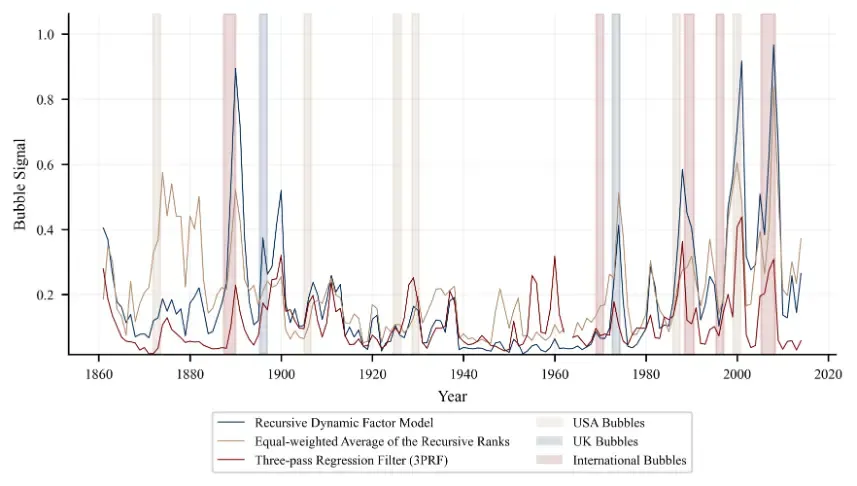
Image: Historical financial bubble signals across three detection models. Source: Grotteria et al., Crying Wolf.
Instead of simply counting how many times journalists mentioned the word "bubble," the researchers used large language models to identify language associated with excessive speculation, concerns about asset valuations, regulatory warnings, and investor euphoria. They then compared their monthly readings against 22 documented financial bubbles across 10 countries.
When the financial press cries wolf
One of the more interesting findings was just how frequently financial journalists get it wrong. Historically, their coverage implied an average 20% probability of a major market crash within six months, compared with an actual frequency of just 5.7%.
What proved useful was measuring how much more concerned journalists became relative to their usual coverage. In 74% of comparisons between months during financial bubbles and ordinary months, the researchers' index registered a higher reading during the bubble, rising to 94% for the dot-com episode.
But the widely cited 97% figure represents the most pessimistic of the researchers' estimates. Two alternative calculations put the probability at approximately 40%.
The index also proved useful in forecasting stock market performance. When tested against data outside its estimation sample, it reduced the average squared error of 12-month Nasdaq return forecasts by 11% compared with predictions based on historical average returns.
AI can succeed even if its investors don't
Nvidia shares had fallen approximately 48% from their peak by last week, while the Nasdaq is trading well below its October record, prompting some analysts to raise concerns of a bubble.
Owen Lamont, a portfolio manager at Acadian Asset Management and former University of Chicago finance professor who previously expressed skepticism about the existence of an AI bubble, has also revised his assessment, recently assigning a 70% probability to the U.S. stock market being in one.
The researchers distinguish between the economic potential of artificial intelligence and the amount of money investors expect to make from it. The internet fundamentally changed the global economy, for example, even though many of the companies that attracted enormous investments during the dot-com boom never survived its collapse.
"The technology may be very productive, but investors are still learning what it is worth," Marco Grotteria, one of the researchers said.
The study also found that central banks and regulators could reduce their expected losses by between 20% and 33% by incorporating the index into their decisions, provided they consider failing to identify a bubble substantially more damaging than issuing a false alarm.
For policymakers who assign equal costs to both mistakes, the researchers found no benefit from using the index.


 USDT

 LINK