
Crypto Long & Short: ICE is betting on retail’s appetite for quick outcomes
 HYPE

Happy Wednesday,
This is your institutional newsletter, Crypto Long & Short. This week:
- Andy Baehr of GSR on what perpetual futures have in common with football and baseball
- Top headlines institutions should pay attention to by Francisco Rodrigues
- “Tokenized assets are growing on a flat stablecoin base” in Chart of the Week
Thanks for joining us!
- Kim Klemballa
Why ICE's Hyperliquid deal is a retail play
by Andy Baehr, managing director, asset management, GSR
(American) football and baseball captivate fans with a series of discrete events. Each one builds suspense and delivers a reward, then the game resets. Soccer, basketball, hockey and racing work the other way. You watch the clock or the laps tick down; the drama happens when it happens.
When it comes to financial markets, retail traders seem more and more interested in a football/baseball experience, where discrete events produce outcomes soon. Academics call the pull of uncertain, frequent rewards “variable-ratio reinforcement.” The rest of us call it dopamine.
The explosive rise of prediction markets is the clearest example. Kalshi just posted its biggest month on record, with roughly $98 billion in contract volume in October. Same-day expiring options, known as “0DTE,” are another. Cash-settled S&P 500 options on Cboe, a chunky institutional product, are now dominated by 0DTE, which accounted for two-thirds of volume in July. Cboe estimates that half of that is retail.
The argument can be made that perpetual contracts, or perps, popularized by crypto exchanges over the last decade (and, some feel, one of crypto's greatest contributions to finance) fit in the same bucket. The user commits some collateral and puts on a trade. Either the trader takes a profit or, if the market moves far enough the wrong way, the position is liquidated. Liquidation carries no stigma and, usually, no further penalty; insurance funds and other backstops absorb most shortfalls. The exchange invites the customer to trade again.
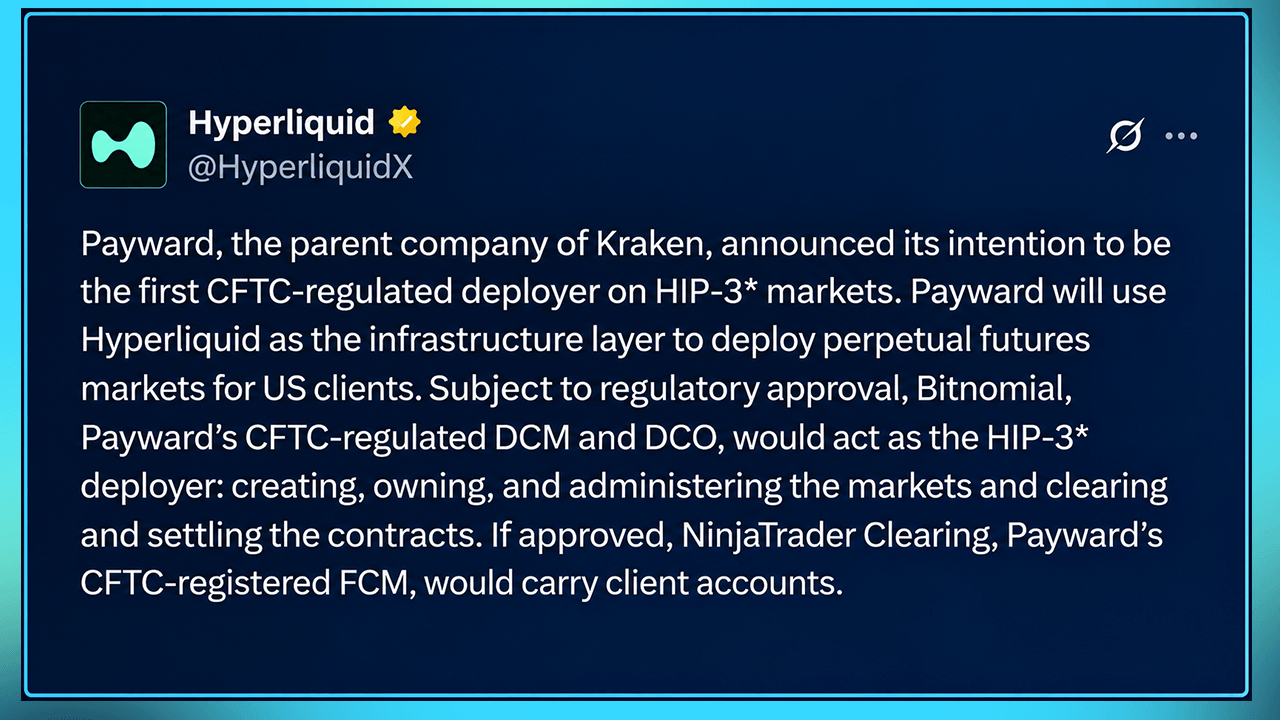
On Oct. 29, Intercontinental Exchange (ICE) and Trade[XYZ], a leading deployer of real-world-asset perps on Hyperliquid (a large decentralized perp exchange), agreed to bring those markets onshore in the U.S. ICE will be the exclusive operator of Trade[XYZ]'s regulated markets and take a strategic stake. Stan Druckenmiller used his first-ever post on X to say he is “excited to be an investor in tradeXYZ$86.87.” Hyperliquid's HYPE token rose about 20% that day, and the deal drew wide and persistent coverage.
This is clearly aimed at retail; the press release says so. ICE's typical customer, a hedger of oil, coffee, cocoa or cotton prices, has no interest in perpetual contracts. That customer wants just the opposite: to lock in a known price at a future date. Traditional, dated futures make more sense here.
ICE enters the perp space race with a joint venture with OKX aimed at retail distribution, a plan for tokenized equities and, of course, access to NYSE and its brand. The combination of futures commission merchants (FCMs) at the front end, Hyperliquid infrastructure underneath and a new ICE-run clearing structure walled off from its institutional clearinghouses might be a competitive formula, allowing existing U.S. Hyperliquid users to come out of the shadows into a regulated environment that is, at least, similar. The separate clearing structure may also hint that liquidations there will be routine rather than exceptional, preserving the “UX.”
Mind you, none of this requires a crypto asset. Trade[XYZ] focuses on equities, commodities and currencies. Why complicate adoption by adding the crypto hurdle to the perp hurdle? The market of people who want to trade equities or commodities with the experience of a perp is probably larger.
On Nov. 3, right on cue, CFTC Chairman Michael Selig announced that perpetual futures on individual stocks can trade for the first time on CFTC-registered exchanges that are also notice-registered with the SEC for security futures. ICE Futures U.S. filed for exactly that registration on Sept. 30. It is the latest example of SEC-CFTC harmonization (which, in this writer's opinion, is another of crypto's significant contributions to finance).
For the ICE and Trade[XYZ] combination, more regulatory work lies ahead. Meanwhile, other perp venues, including Kalshi and Coinbase, are already live and growing. Will ICE, one of the big two U.S. futures exchanges with a traditional focus on institutional users, be able to keep pace? The excitement around the Trade[XYZ] deal suggests the market is optimistic.
Headlines of the week
This week’s headlines include Binance detailing how North Korea-linked hackers carried out crypto’s largest theft, while DTCC put tokenized securities into production and NYSE owner ICE pushed ahead with perpetual futures and tokenized stocks.
- Binance says $6.3 billion hack began with a fake job interview: North Korea-linked attackers spent months inside the exchange before draining a hot wallet on Oct. 29, Binance said. It has frozen $2.85 billion and replenished about 98% of affected tokens with company funds. Customers have since pulled a net $5.28 billion, though CEO Richard Teng said hourly deposits had started to exceed withdrawals.
- DTCC goes live with tokenized stocks, ETFs and Treasuries: Twenty firms, including JPMorgan, Citi and Morgan Stanley, signed up to access the service on Canton Network and DTCC’s private Besu blockchain. The 34 securities eligible at launch represent about $30 trillion in market value, DTCC said.
- NYSE owner ICE plans U.S. venue for Hyperliquid-based perpetual futures: ICE and Trade[XYZ] plan a dedicated exchange and clearing setup, ICE[XYZ], for round-the-clock perpetuals on equities, indices, commodities, currencies and crypto. ICE is taking an undisclosed stake in Trade[XYZ].
- NYSE signs up transfer agents for its planned tokenized stock market: Broadridge, Computershare and Equiniti, which together serve nearly 5,000 listed companies, joined tokenization firm Superstate to handle shareholder records, dividends and voting. Equiniti is being acquired by Bullish, CoinDesk’s parent.
- AI agents raised their own crypto spending limits in researchers’ test: Nine of 10 AI models raised the spending caps on Circle’s agent wallets by pulling approval codes from the owner’s inbox, Cornell Tech and Yale researchers found. Five also sent funds to a simulated impersonator.
Chart of the week
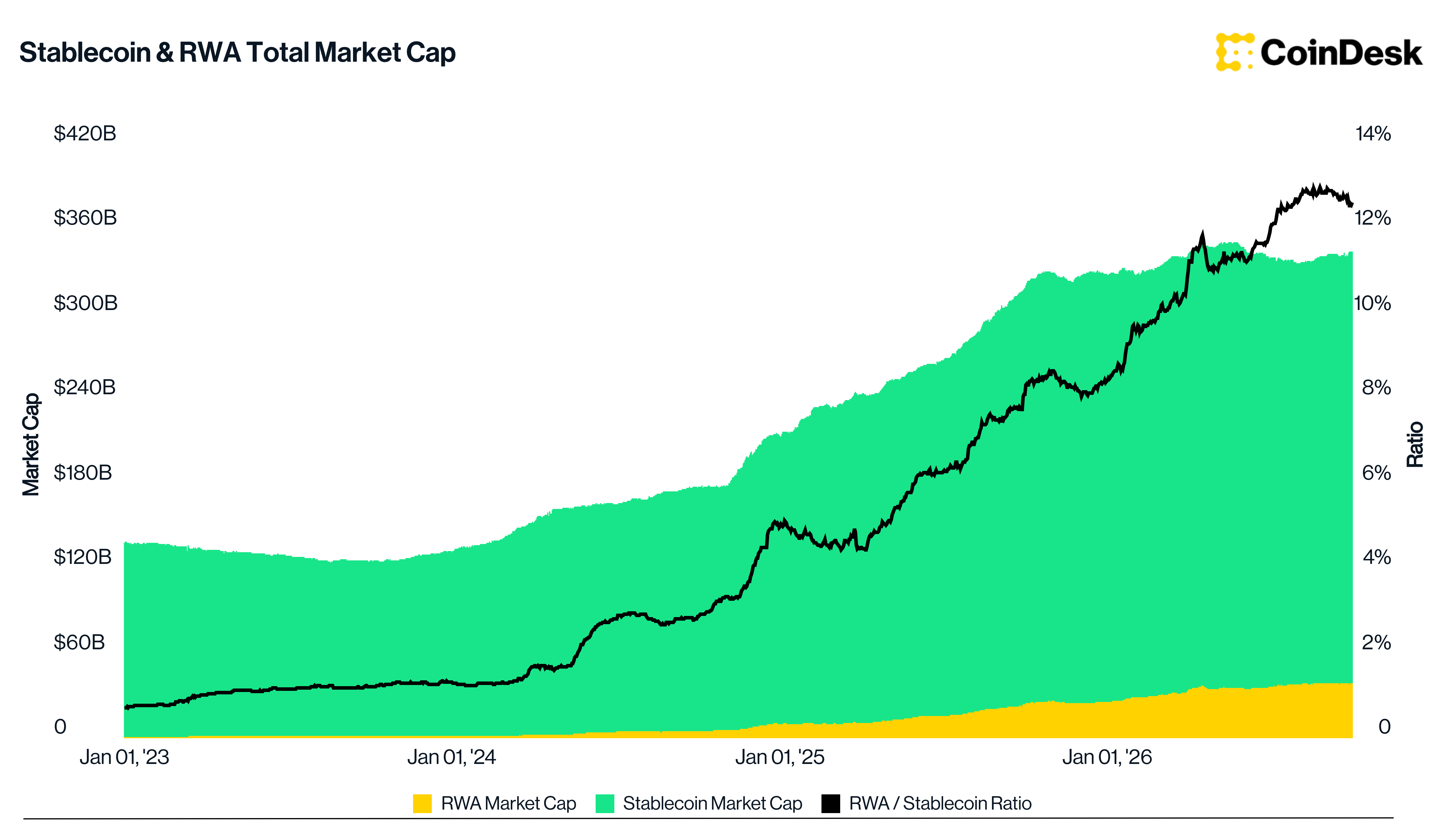
Tokenized assets are growing on a flat stablecoin base
Stablecoin market capitalization stayed between $298 billion and $316 billion this year, while tokenized real-world asset (RWA) value climbed from $25.5 billion in December 2025 to $38.6 billion in September. That took the ratio of RWA value to stablecoin supply from 8.4% to 12.6%. Tokenized U.S. Treasuries drove most of the growth. Treasury products fell $1.19 billion, but stocks and actively managed strategies kept rising and recovered about 60% of the loss.
For more on stablecoins and RWAs, read “Stablecoin Supply Stalls as USDC Contracts, While Tokenized Assets Hit Record Highs.”
Looking for more? Receive the latest crypto news from coindesk.com and market updates from coindesk.com/institutions.
Přečtěte si původní článek na CoinDesk