Bitcoin rebounds from 2-year low as Wall Street futures recover
 BTC
Bitcoin is trading around $61,500 as U.S. stock index futures advance, setting up the first test of whether crypto’s weekend rebound holds once Wall Street reopens.
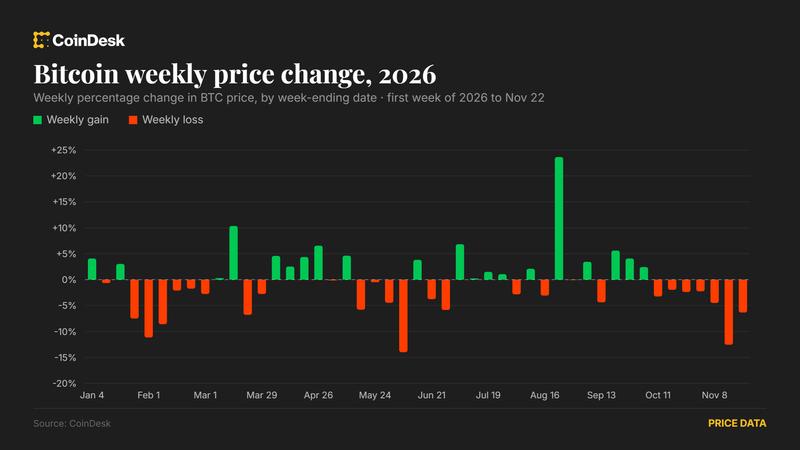
Nasdaq 100 index futures have rallied almost 3% after the index posted its worst week since March 2020. S&P 500 futures are about 2% higher. Last week’s equity selloff pushed the S&P 500 into a correction and dragged bitcoin to a low of $55,130 early Saturday UTC, its weakest level since September 2024.
The largest cryptocurrency has gained about 1.9% since midnight Sunday UTC and the CoinDesk 20 Index has added 2%.
Crypto and tech stocks fell together through the rout. Today’s activity will provide a read on whether traders see the decline as a dip and add to their holdings, or whether they abstain and the bounce fades.
Near-term levels are tight. Bitcoin faces resistance between $62,000 and $65,000, while a break below the $55,000–$56,000 lows could open a move toward $53,000, according to KuCoin's daily market report.
Spot bitcoin ETF flows are the other signal to watch. The funds have bled nearly $3 billion in November, and a turn to inflows would suggest the rebound has buyers behind it rather than just short covering.
Derivatives Positioning
Futures are quiet: Over 24 hours, cumulative crypto futures open interest (OI) slipped 0.1% to $105.2 billion while trading volume rose 0.3% to $142.2 billion. Both moves are too small to signal fresh capital inflows or meaningful position unwinding, which suggests traders held their positions steady. Liquidations fell 57% to $206.9 million, showing far less forced selling than the day before.
BTC’s mild bullish lean: Bitcoin perpetual funding was positive on most major exchanges, meaning longs paid shorts a small premium, while 24-hour OI-adjusted cumulative volume delta (CVD) was positive, pointing to net market-order buying. Positioning leans mildly bullish.
ETH divergence: Ether funding was negative across all major exchanges, meaning shorts paid longs to hold their positions, even as 24-hour CVD was positive. Market-order buying and negative funding together make positioning mixed.
Funding tilt: Dogecoin showed the most consistently positive funding, with rates positive on every venue that lists it, while Cardano was the most negative. On Binance, more coins showed negative funding than positive, meaning shorts are paying to hold bearish bets across much of the altcoin market.
CVD mixed: On a 24-hour basis, OI-adjusted CVD was mixed. BTC, ETH and a few others were positive, while avalanche (AVAX) and BNB led the negatives. Over the week, tron and zcash were the only majors with positive CVD, and litecoin was the most negative, showing that market-order selling has dominated most large coins for the past seven days.
Liquidation map: On Binance's BTC/USDT perpetual, about 64% of estimated open liquidation levels sat below the price, meaning long positions, against 36% above. The biggest single cluster, about $43 million, sat near $60,335, roughly 1.6% below the current price, so a drop toward that level could force more selling than a similar rally would force buying.
BTC options stress: The term structure of bitcoin's implied volatility was inverted, with front-end expiries priced near 58% against about 45% for longer-dated contracts, a sign of elevated near-term uncertainty. One-week ATM implied volatility jumped from the 30s in October to above 50%, and the 25-delta skew rose to around 20%, near its highest in a year, showing puts priced well above calls. The Nov. 27 $50,000 put and the Dec. 25 $20,000 put were the most-traded contracts, closely followed by the Dec. 25 $78,000 call.
ETH call activity: Ether's volatility term structure was also inverted, and its short-dated 25-delta skew sat near 15% to 20% in favor of puts. Even so, the Dec. 25 $2,300 call was by far the most traded ether option, with roughly eight times the volume of the next most active contract.
Token Talk
- AI-linked tokens are leading the crypto rebound. Venice rebounded to around $26 after falling below $20 over the weekend, up about 30% on the week, while BNB Chain-based AI payments token PIEVERSE set a record above $5 on Sunday before falling back to around $3.60.
- DRV, the token of Derive, the largest decentralized options exchange, has gained about 38% over seven days to roughly $0.36. The move seems to be linked to rising demand for options trading during the recent volatility.
- Chainflip's FLIP plunged 32% over 24 hours after the cross-chain exchange said an attacker took 122.86 BTC from its bitcoin vault. Chainflip has offered a 10% bounty if 90% of the funds are returned today, and the token has since stabilized.
- Hyperliquid's HYPE is up about 4% to around $64, recovering part of last week's drop after Hong Kong's securities regulator flagged the exchange as unlicensed and the U.S. CFTC said it must register to serve U.S. traders. Its buyback fund added another $2.5 million of HYPE.
- Sentiment remains deeply negative. CoinMarketCap's Fear and Greed Index is at 9, in extreme fear, while bitcoin's share of total crypto market value is near 59%, a sign there’s little appetite for altcoins.
Fler nyheter