

What Democrats’ US midterm sweep means for the CLARITY Act
Crypto companies contributed $233 million to political committees during the 2026 US midterm cycle, according to Public Citizen’s analysis of federal filings.
Democrats won both chambers of Congress and will take control in January, giving them a chance to reshape the stalled CLARITY Act, a bill to set federal rules for crypto markets.
In Ohio, Democrat and longtime crypto skeptic Sherrod Brown defeated Republican Sen. Jon Husted despite crypto-backed political action committees spending $64 million to defeat him.
Senator Elizabeth Warren, one of crypto’s most vocal critics in Washington and the most senior Democrat on the Senate Banking Committee, is expected to chair the panel in the next Congress.
Stronger consumer protections, tougher scrutiny of political conflicts and a shift in regulatory power are all likely to be on the docket in the next round of negotiations.
But a Democratic majority doesn’t have to kill the prospect of crypto market structure legislation completely.
Democrat Congressman Shri Thanedar remains hopeful that the CLARITY Act can still pass, but says any legislation must include stronger ethics requirements. He tells Magazine:
“President Trump’s blatant corruption has set back progress on crypto legislation, so Democrats will need strong anti-corruption provisions that apply to the President, not just Congress.”
Can the industry’s political influence still be converted into legislation, and what will it have to concede to get there?
A different deal for crypto
The Senate failed to advance the CLARITY Act in September, with disagreements over ethics provisions contributing to the impasse.
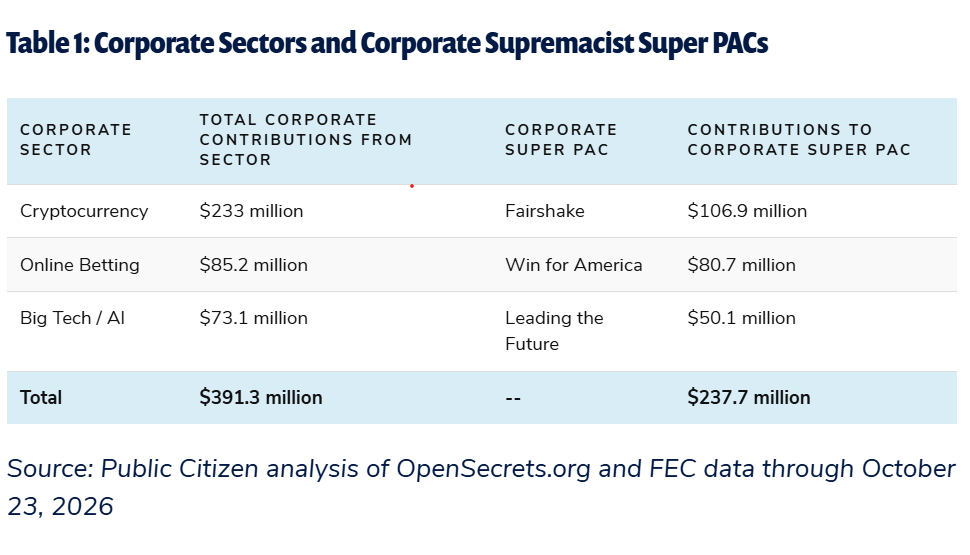
The crypto spent $233 million on the 2026 US midterm elections. Source: Public Citizen
Democrats are already reportedly discussing how to reshape the market structure debate, with House Democrats said to be considering expanding proposals from Representative Maxine Waters into a broader market structure bill.
That bill could include stronger consumer protections, a greater role for the Securities and Exchange Commission, and new ethics restrictions on public officials’ crypto activities.
That could finally mean separating the industry’s push for clearer rules from the controversies surrounding Trump’s personal crypto ventures.
Democrats have already signaled plans to investigate the Trump family’s business dealings and other corporate interests, with incoming House Oversight Committee Chair Robert Garcia planning to pursue inquiries into corporate corruption.
Hadley Stern, head of institutions at Silence Laboratories and founder of Fidelity Digital Assets, says Democrats are right to “go after” the second, and the industry should want them to; that’s “what’s poisoning the bipartisan deal,” he says.
“A sitting president’s family launching memecoins and a stablecoin is a real governance problem,” he tells Magazine. “If I’d done that at Fidelity, I’d have been walked out the same afternoon.”
He says 2026’s digital asset industry is very different from the last time Democrats “held the gavel,” pointing to its growth from “FTX and a bunch of tokens” in 2022 to a federal law for stablecoins, Treasuries and credit funds onchain and tokenized equities on the way:
“You don’t regulate that by pretending it doesn’t exist.”
What would the industry have to concede?
The industry may also have to accept more demanding standards if it wants legislation that can survive changes in political control.
Paul Brody, founder and CEO of Nightfall Networks and former global blockchain lead at EY, expects banks “to come out winners,” as they will “push for crypto companies” to be held to the same exacting consumer protection and security standards.
He says the industry has opposed this, but tells Magazine that “a wise strategy” would be to “accept similar conditions,” given that blockchain-native ecosystems are still “vastly more flexible, programmable and efficient.”
Lindsay Fraser, chief policy officer at Blockchain Association, also argues consumer protection and innovation should not be treated as competing objectives.
“We can protect consumers while ensuring the law reflects how the technology actually works,” she says, adding the goal is “lasting policy that earns public trust, gives builders a future in this country, and strengthens American financial leadership.”
That doesn’t mean it’s all smooth sailing to a potential compromise.
Brody says there’s still the possibility of a presidential veto, and points out that crypto is likely to be a “low priority” compared to “investigations of corruption and battles over budgets and the war.”
How the Binance hack could influence lawmakers
The midterm results came as lawmakers were already grappling with the fallout from the Binance hack, the largest hack in crypto history, with over $6.3 billion stolen on Oct. 29, raising fresh concerns about exchange security and customer protections.
Thanedar says while the legislation “wouldn’t solve every potential problem,” it would provide “much-needed certainty” and “security guardrails,” and the hack provides a “clear example of the danger of not enacting appropriate legislation.”
Maylea Ma, deputy general counsel at 1inch, says rather than making a stronger case for passing the latest draft of CLARITY, the incident “highlights problems the legislation does not address.”
The hack involved a “centralized exchange’s hot wallet and signing failure,” Ma says, but the current draft “has no insurer, no loss payee, and no hot wallet cap that would have mitigated the loss for Binance or imposed security standards that would have prevented the hack.”
Amanda Fischer, policy director at Better Markets, said the episode highlighted how “unfit for purpose the crypto ecosystem is for mainstream finance,” and crypto exchanges should not act as custodians, since it creates a “honeypot risk.”

Binance hack shows how ‘unfit’ crypto is for mainstream finance. Source: Amanda Fischer
Ma says the incident is “likely to impact” the next vote on CLARITY and could make lawmakers less willing to pass legislation the industry wants, unless it comes with stronger consumer protections.
Crypto spent years convincing Washington it deserves a seat at the table; now it will need to agree on the obligations that come along with it.
*Magazine:* *Bitcoin turns 18: Has the original rebel grown up?*
Läs originalet på Cointelegraph
Fler nyheter

Beyond APY: Farewell to Black-Box Trust, Reassessing the Security Logic of ETH Staking
 ETH
Could Adjusting Gas Pricing Actually Cause Smart Contracts to Fail? Ethereum Urgently Halts Hoodi Fork to Investigate Eight Major Security Vulnerabilities

 BTC