Bitcoin Price Tests $64K Amid Anthropic IPO—Then Falls Back Near $62K
 BTC
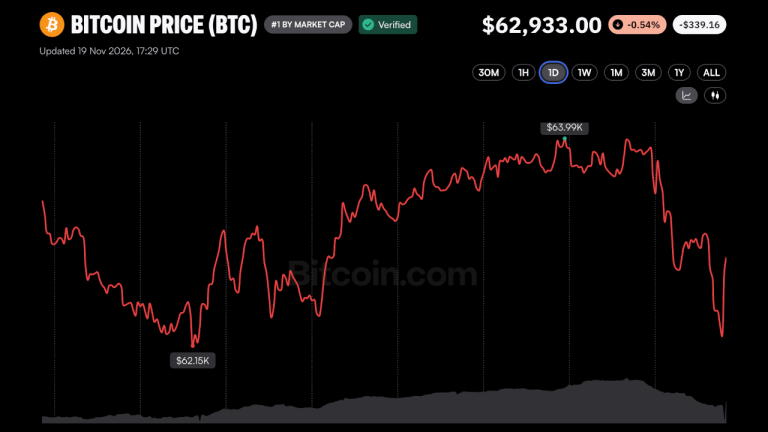
Bitcoin briefly rallied to $64,005 alongside a tech stock surge sparked by Anthropic’s record $81 billion IPO, before dropping back below $63,000 and wiping out over $350 million in crypto-wide leveraged positions.
Kľúčové body
- Bitcoin tapped $64,005 after Anthropic’s $81 billion IPO before sliding back below $63,000.
- Intraday swings wiped out $350 million in crypto positions as 38% of fund managers flag AI overinvestment.
- Ryan Kirkley expects tighter liquidity to drive institutional adoption of stablecoins and 24/7 settlement rails.
Intraday Volatility Wipes Out $350M in Crypto Positions
Bitcoin briefly rebounded from Wednesday’s slide to tap the $64,000 threshold, moving in tandem with tech stocks that surged following Anthropic’s record-breaking $81.3 billion initial public offering.
As the daily price chart shows, the top cryptocurrency’s recovery began in the early hours of Thursday after largely fluctuating between $62,000 and $63,000. An hour before midnight ET, the price jumped from $62,416 to $63,573 before ascending slowly to a daily peak of $64,005.
True to its volatile nature, bitcoin shed those gains just as quickly, plunging to just over $62,800 in less than two hours. By 12:30 p.m. EST, bitcoin was again near the $63,000 level after dipping close to $62,300, sitting at a market cap close to $1.27 trillion. At that recent price, the coin was down 0.4% over the last 24 hours.
The sharp swings wiped out more than $116 million in bitcoin leveraged positions, with liquidated long bets accounting for $78 million of them. Across the broader crypto economy, total liquidations surpassed $350 million, including more than $242 million in wiped-out long bets.
While Anthropic’s landmark listing provided a temporary lift to risk assets, broader institutional sentiment toward the technology sector is showing signs of strain. According to Ryan Kirkley, co-founder and CEO of Global Settlement Network, Bank of America’s latest fund manager survey shows technology exposure falling at its fastest monthly pace in two decades, with 38% of respondents concerned that companies are overinvesting in artificial intelligence (AI).
Tech Exposure Retreats Amid AI Financing Concerns
Kirkley views the pullback as a “reassessment of valuations and capital efficiency rather than a wholesale rejection of technology.” He noted that while investors spent much of the past two years financing growth on anticipated AI demand, those bets are harder to justify amid elevated borrowing costs and still-developing returns on infrastructure investments.
“Institutional investors are becoming more selective about where they deploy capital, and I expect that discipline to extend into digital assets,” Kirkley said. “Bitcoin is unlikely to be insulated from a broader reduction in risk appetite. When institutions reduce exposure to technology equities, crypto can face similar selling pressure because both remain sensitive to liquidity conditions.”
Questions surrounding Nvidia’s market leadership and the financing of smaller AI cloud providers have further highlighted how heavily tech growth relies on inexpensive capital. Kirkley warned that smaller, debt-heavy infrastructure providers are particularly exposed if lenders demand higher returns, creating interconnected risks that could spill over into digital assets. Should AI financing concerns prompt investors to unwind leverage and adopt defensive positions, bitcoin and other cryptocurrencies could face heightened volatility.
Despite near-term macroeconomic headwinds, Kirkley distinguishes short-term price fluctuations from the long-term investment case for blockchain infrastructure. He argues that tighter funding conditions strengthen the commercial utility of digital settlement rails as capital tied up in lengthy clearing processes grows increasingly expensive for institutions.
“The next phase of institutional adoption will be driven less by speculative valuations and more by measurable improvements in how capital moves,” Kirkley said. “Stablecoins, tokenized assets, and real-time settlement infrastructure have an opportunity to demonstrate value by reducing friction, improving liquidity management and making financial transactions more efficient.”
Ultimately, Kirkley noted, the goal of regulated stablecoins and faster settlement infrastructure is not merely speed, but reducing the idle capital institutions must hold against unsettled transactions.
Prečítajte si pôvodný článok na Bitcoin.com
Viac správ