Even a $1 Million Boost from Grayscale Couldn’t Save It: Why Did ZEC, Hyped as a Top Pick, Crash Again?
 ZEC
One moment hailed as the premier privacy upstart, the next turned into an ATM for leveraged liquidations.
Author: Kuli, TechFlow
TechFlow Highlights:
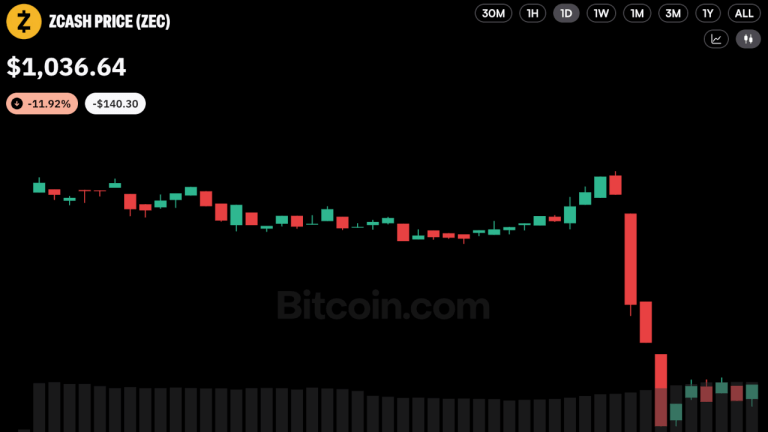
On November 10, Grayscale announced a $1 million ecosystem sponsorship program, pledging to return all management fees collected from its Zcash ETF (ZCSH) in the first year to network development and marketing. The initial batch distributed $100,000 each to four non-profit organizations. However, on the same day the positive news was implemented, ZEC's price plummeted 11.3% to around $1,043, with its 30-day decline widening to nearly 20%. Throughout the previous two months, ZEC had been highly promoted by overseas KOLs and institutions, hailed as experiencing a "second spring" for older coins. Squeezed by open interest amounting to $2.3 billion, it quickly entered a steady downtrend. This means the narrative halo of Wall Street and Grayscale's PR subsidies have run out. Stripped of fundamental support, ZEC has once again become a cash-extraction machine for highly leveraged speculative capital using good news to exit positions.
If you frequently scrolled through social media one or two months ago, ZEC was undoubtedly the most eye-catching darling among various influencers and crypto research reports.
The narrative at that time was highly tempting: the successful launch of a spot ETF on NYSE Arca in August, the "breakthrough acceptance" of privacy narratives by mainstream Wall Street finance, and the value re-evaluation of an old major player dormant for years... Various bullish slogans flew everywhere, making it seem as if this ancient privacy coin was about to take over and return to the frontline stage.
But reality soon delivered a loud slap in the face.
On November 10, Grayscale announced a highly sincere supportive move: pledging to contribute $1 million from the management fees collected by its Zcash ETF (ticker ZCSH) to fully fund the Zcash ecosystem.
The first tranche has already been disbursed, with four non-profit organizations including the Zcash Foundation each receiving $100,000. Grayscale even launched a nationwide advertising and investment education website simultaneously.
Institutional real money poured into the ecosystem only to be met with a sharp blow to the chart.
On the day the news was announced, ZEC slid throughout the intraday trading session, plunging 11.3% in a single day to around $1,043. Looking at a longer timeframe, it has already retraced nearly 19% over the past month. The noisy buy calls still echoed in ears, while retail investors chasing the high were already solidly standing atop the peak.
A $1 Million Voluntary Subsidy Cannot Buy Real Ecosystem Prosperity
On the surface, Grayscale's approach of "returning all ETF fees to the public chain ecosystem" serves as an industry benchmark, exceptionally rare even in traditional asset management circles.
But looking closely at the clause details, beneath this warm veneer lies nothing but calculated maneuvering.
As clearly stated in the official announcement, this $1 million commitment is of a "voluntary nature," and Grayscale retains the right to modify or directly terminate the sponsorship at any time. To put it bluntly, the initially executed portion is merely the $400,000 allocated to four institutions, leaving the remaining $600,000 more like a carrot dangling ahead. Rather than an ecosystem donation, it is better described as a brand marketing campaign by Grayscale to promote its own ZCSH fund.
What is even more awkward is the stark disparity in scale.
Against the backdrop of Zcash's massive market cap, a $1 million development and marketing sponsorship doesn't even amount to putting out a fire with a cup of water. Since its listing on NYSE Arca in August, the Zcash ETF has not triggered the frantic buying frenzy from traditional capital that previously occurred with Bitcoin or Ethereum ETFs.
Wall Street has placed the ticker on the screens, but the number of funds willing to commit real money for long-term allocation is exceedingly small.
Without continuous injection of new off-exchange liquidity, relying solely on the meager promotional funds paid out-of-pocket by institutions cannot possibly sustain the narrative bubble that was severely inflated over the past two months.
$2.3 Billion in Contracts Looming Overhead, Speculative Hot Money is Accelerating Harvest
The brittle breakdown in price stems fundamentally from the position structure.
Data shows that the current open interest (OI) for ZEC perpetual contracts across the entire network reaches approximately $2.3 billion. Currently circulating within ZEC are more akin to a group of high-volatility leverage gamblers.
Therefore, looking back, the aggressive promotion of ZEC on overseas social media over the past two months resembles less of a genuine investment call and more of a precisely targeted harvest of derivative market liquidity.
Market makers capitalized on the positive theme of the "first privacy ETF launch" to rapidly drive up hype in a very short time, enticing onshore retail investors to follow suit with leveraged longs. When contract open interest hit ceiling levels and Grayscale's sponsorship news finally materialized, it perfectly served as the optimal liquidity exit window for major players to reverse their positions, closing longs, or even initiating shorts to crash the market.
Moreover, Zcash's own trust scars have not truly healed.
Approximately three months before the ETF launch, a fatal vulnerability in Zcash's privacy pool was exposed, directly causing the coin's price to halve and plummet by 50% in a short period. Although the technical team completed the fix in July, in an era where mainstream regulatory compliance is already extremely wary of privacy technology, this technical scare completely shattered the confidence bottom line of many conservative funds.
On one hand, there is a technical network lacking genuine user retention; on the other, looming leverage amounts to $2.3 billion. Subjected to even minor macro corrections or profit-taking on positive news, a long squeeze is almost an inevitable outcome.
The Familiar Flavor of a Cash-Out Machine
In the crypto market, "retrading old coins" has always been a dangerous business.
From early fork tokens to today's privacy coins, the script's trajectory is often highly consistent: find an excuse recognized by traditional fiat capital, package it into a grand narrative of "value re-evaluation", use overseas KOLs to concentrate momentum and attract momentum-buying orders, and finally complete chip distribution at the moment when liquidity is most feverish.
Most of those who hailed ZEC as the hottest pick over the past two months have already secured profits and exited; what remains on the charts now is only the mess of breaking below the $1,000 level, along with a liquidity stalemate involving $2.3 billion in unsettled positions.
For investors blinded by the promo calls, the expectations overdrafted over the past two months have now been entirely unwound; for Zcash itself, Grayscale's billboards cannot save it. If older coins hope to achieve a second spring, relying solely on sponsorship fees bestowed by Wall Street is obviously far from enough.
Czytaj oryginał na Techflowpost